Part 2 of the Bend Surveillance Oversight series.
Before Bend residents can have a useful conversation about police surveillance oversight, we need to understand what technology the City has already approved, discussed, or bundled into larger contracts.
This is not about assuming bad intent.
It is about making the public record easier to understand.
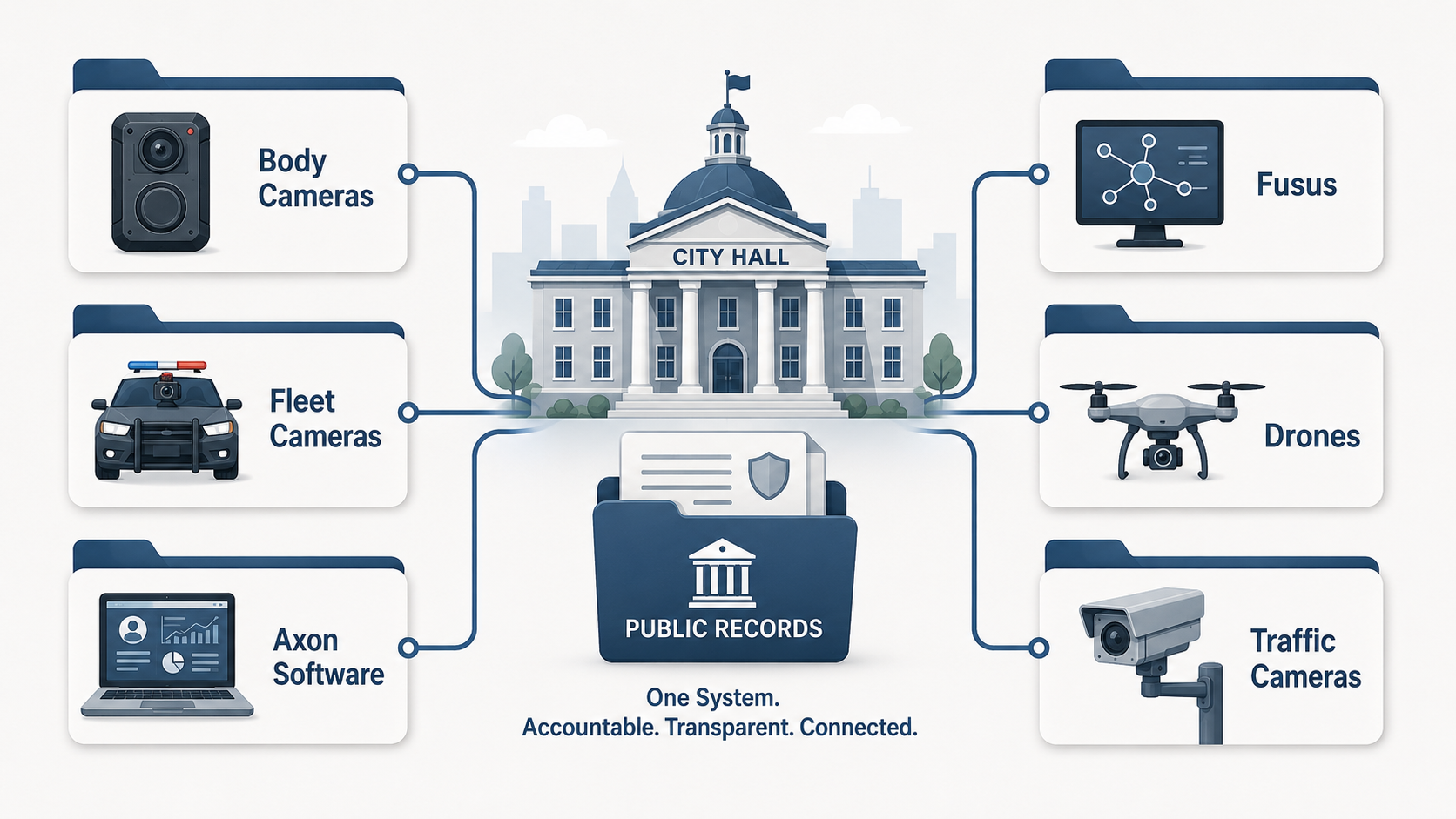
Over the past several years, Bend has moved from body-worn cameras into a broader police technology ecosystem involving vehicle cameras, cloud evidence storage, drone software, real-time information tools, third-party video playback, investigation software, and bundled Axon subscriptions.
That is why this conversation should not be reduced to a simple question like, “Should police have cameras?”
The better question is:
What systems has Bend adopted, and what public rules govern the data those systems create?
Body-worn cameras and Evidence.com
In April 2021, Bend City Council considered a five-year agreement with Axon for body-worn cameras, associated hardware, analytical software, training, and digital evidence storage, with a contract amount not to exceed $1,038,996.
The City’s issue summary said full implementation would mean every officer would be equipped with a body-worn camera during their shift, video recordings would be stored, and the Deschutes County District Attorney’s Office would have the ability to receive the information.
That matters because body cameras are not only recording devices. They also create records that must be stored, accessed, shared, retained, and governed.
Fleet cameras in police vehicles
In July 2022, Bend City Council approved a five-year, $679,500 contract with Axon for fleet cameras in Bend Police vehicles.
The City described the contract as covering purchase and installation of cameras, software, and video storage.
This is important because fleet cameras can be more than dashboard video. Depending on the hardware, software, and enabled features, vehicle camera systems can interact with evidence storage, metadata, automated review tools, and potentially other software capabilities.
That is exactly why public policy should focus on capabilities, retention, access, and auditing — not just the word “camera.”
Fusus real-time information software
In March 2023, Bend City Council considered a three-year agreement with Fusus Inc. for software and associated hardware to view public and community video sources for incident situational awareness and investigations, with a contract amount not to exceed $230,000.
The City’s issue summary described Fusus as a real-time crime center platform designed to consolidate video and other information sources.
It said Fusus could bring together public and private video systems, community tips, community text notifications, Computer Aided Dispatch, unmanned aircraft video, Live 911 information, body-worn cameras, in-car cameras, a community camera registry, a CJIS-compliant video evidence vault, and video live links for 911 callers.
That is a much broader system than a single camera.
It is a platform for gathering, viewing, and coordinating multiple information sources in one place.
Axon Air and drone software
In February 2024, Bend considered additional Axon Air software licenses for its drone program.
The issue summary said Bend Police had been using Axon Air software since 2022 for drone support and remote viewing capabilities, and that the department wanted additional pilot and drone licenses.
It also stated that Bend Police had been using Axon services since 2021 as a unified platform to better track deployment, usage, and results of police actions.
That phrase — unified platform — is important.
It shows the direction of travel: not isolated tools, but integration of multiple police technologies into one vendor ecosystem.
2024 Axon bundled contract
In October 2024, Bend City Council considered a five-year Axon Officer Safety Plan 10 Premium subscription.
The meeting minutes state that Council authorized a five-year contract with Axon for Taser hardware, virtual reality hardware and software, digital video recorder playback support, and investigation support software, for a total amount not to exceed $2,555,786.51.
The minutes also identify the new bundled products and services as Investigate Pro, Third-Party Video Playback, and Virtual Reality training.
This is the clearest example of why residents need a public inventory.
Once products are bundled together, it becomes harder for the public to understand which tools are active, which are planned, which are optional, and which could be expanded later.
Automated traffic enforcement cameras
Separate from the Axon materials, Bend has also moved forward with automated traffic enforcement.
The City says the program uses cameras to detect red-light running and speeding at various intersections.
This is a different type of camera program, but it belongs in the same public conversation because it raises the same basic governance questions:
- What data is collected?
- Who operates the system?
- How long is the data retained?
- Who can access it?
- What rules prevent secondary use?
Why this matters
Looked at separately, each item may sound narrow:
- A body camera contract.
- A fleet camera contract.
- A drone software license.
- A real-time information platform.
- A video playback tool.
- An investigation software tool.
- A traffic enforcement camera program.
But viewed together, they show a larger pattern: Bend is building a police technology environment made of cameras, cloud storage, software subscriptions, vendor platforms, and integrated data systems.
That does not mean the City should abandon useful tools.
It does mean residents deserve a clear, public inventory.
The first step toward meaningful oversight is simple:
Tell residents what systems exist.
Selected source documents
- April 7, 2021 Bend City Council Axon body-worn camera issue summary
- City of Bend: Bend City Council approves fleet camera system for Bend Police vehicles
- July 20, 2022 Bend City Council fleet camera issue summary
- March 15, 2023 Bend City Council agenda — Fusus item
- February 7, 2024 Axon Air issue summary
- October 2, 2024 Bend City Council meeting minutes
- City of Bend Automated Traffic Enforcement Program