Part 3 of the Bend Surveillance Oversight series.
In the last post, we looked at the range of police technology Bend has already considered, approved, or discussed: body-worn cameras, fleet cameras, digital evidence storage, Fusus real-time information software, Axon Air drone software, third-party video playback, investigation software, VR training, and automated traffic enforcement cameras.
Looked at one at a time, each purchase can sound narrow.
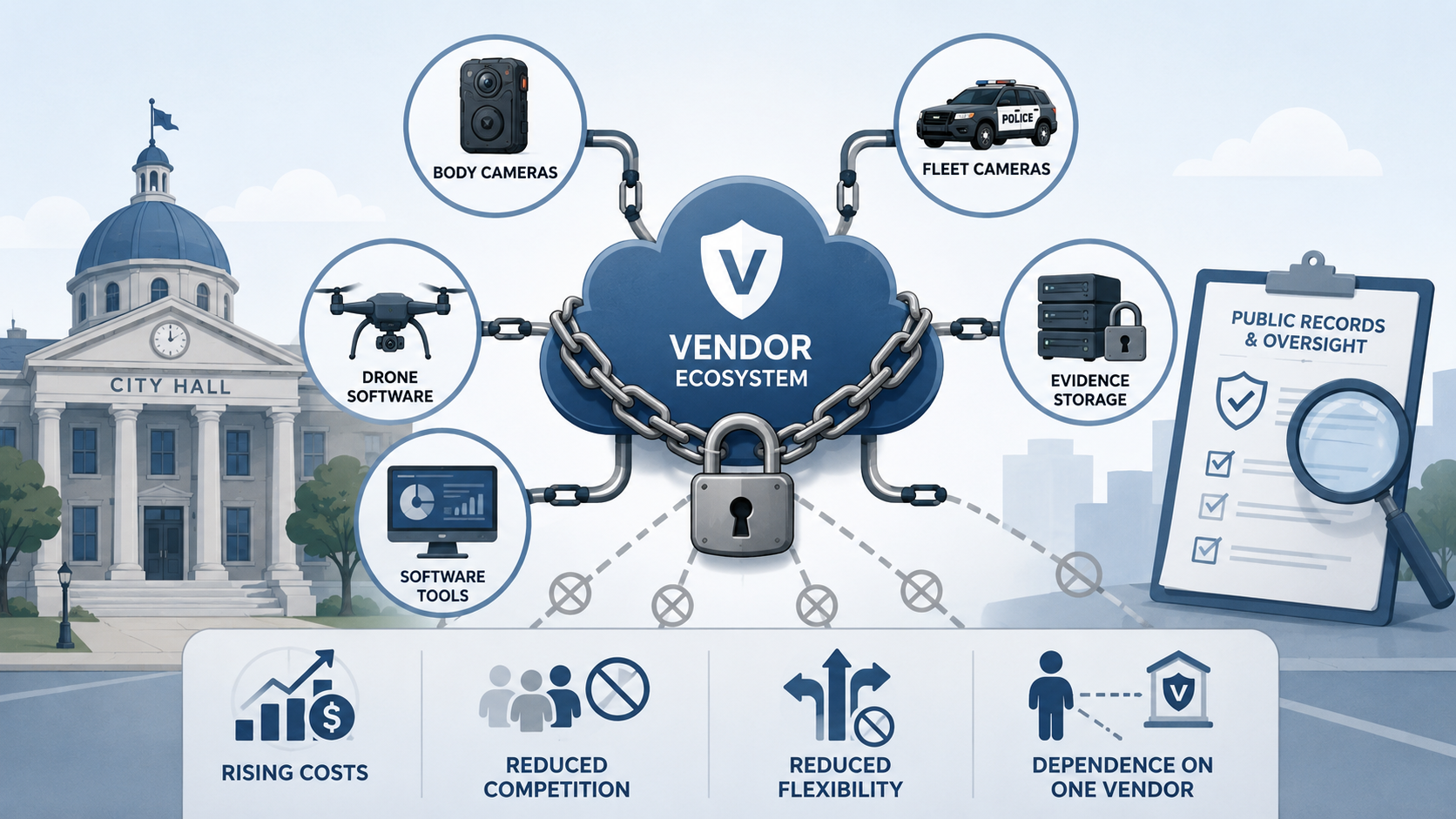
But when the same vendor ecosystem provides the cameras, storage, software, subscriptions, hardware refreshes, training tools, review tools, and add-on features, the City may gradually become dependent on one platform.
That is called vendor lock-in.
Vendor lock-in does not necessarily mean anyone did anything wrong.
It means a city’s systems, data, workflows, training, contracts, and budgets become so tied to one vendor that switching later becomes expensive, disruptive, or politically difficult.
That matters for public oversight.
How lock-in happens
A city might begin with a legitimate need: body cameras.
Then it needs a place to store the video, so it adds cloud evidence storage.
Then prosecutors need access, so the system becomes part of the criminal justice workflow.
Then patrol vehicles need cameras, so fleet cameras are added.
Then drone video needs to be managed, so drone software is added.
Then the department wants video review tools, third-party video playback, investigation software, AI tools, or real-time information platforms.
Over time, what began as a camera contract can become a broad public safety software ecosystem.
The Electronic Frontier Foundation has warned about this pattern in its article “Beware the Bundle”, which describes how police technology companies can use bundled offerings to become a department’s default provider for more and more tools.
Again, the issue is not whether any single tool is useful.
The issue is whether the public understands how the tools fit together before the City becomes deeply dependent on the platform.
Why bundled contracts are harder to oversee
Bundled contracts can make public oversight harder for several reasons.
First, bundles can obscure what is actually being purchased.
Second, bundles can make costs harder to compare.
Third, bundles can reduce practical competition.
Fourth, bundles can normalize expansion through amendments.
That is how surveillance systems can grow without residents ever seeing a single clear moment where the full policy question is debated.
Vendor assurances are not the same as public policy
Cities often rely on vendor statements about what a system does or does not do.
That is not enough.
- Vendors can change product features.
- Software capabilities can be added later.
- Terms can change.
- Subprocessors can be involved.
- Data can be stored in complex cloud systems.
- Departments can expand use over time.
- Future renewals can make earlier decisions harder to revisit.
That is why public rules should not depend only on vendor assurances or internal department practices.
Public policy should be clear enough that residents can understand the limits before the next expansion happens.
Why this matters in Bend
Bend has already considered or approved multiple related technology systems over time.
That does not prove a problem by itself.
But it does show why residents should ask how all of these systems connect, whether alternatives were seriously evaluated, and what would happen if the City later wanted different pricing, stronger privacy protections, or more independent technical control.
Vendor lock-in is not only a procurement question.
It is also a transparency and governance question.
What better contract oversight would look like
If Bend wants useful technology without becoming overly dependent on one vendor ecosystem, contracts should protect the public interest.
That can include:
- clear exit clauses,
- data portability requirements,
- limits on automatic renewals,
- public review before major expansions,
- independent audits of enabled features and system settings, and
- Council approval before materially new capabilities are activated.
Those are not anti-technology ideas.
They are basic governance safeguards.
The real question
The question is not whether Bend should use one vendor or another.
The question is whether Bend has enough public oversight before the technology ecosystem becomes too large, too expensive, and too embedded to easily change.
Vendor lock-in is not just a budget issue.
It is a democracy issue.
When public safety technology becomes hard to leave, hard to audit, and hard for residents to understand, public oversight becomes weaker.
That is why Bend should address vendor lock-in now, before future expansions become automatic.