Tag: License Plate Readers

  • ALPRs: License Plate Scans Are Location Records

    ALPRs: License Plate Scans Are Location Records

    Part 6 of the Bend Surveillance Oversight series.

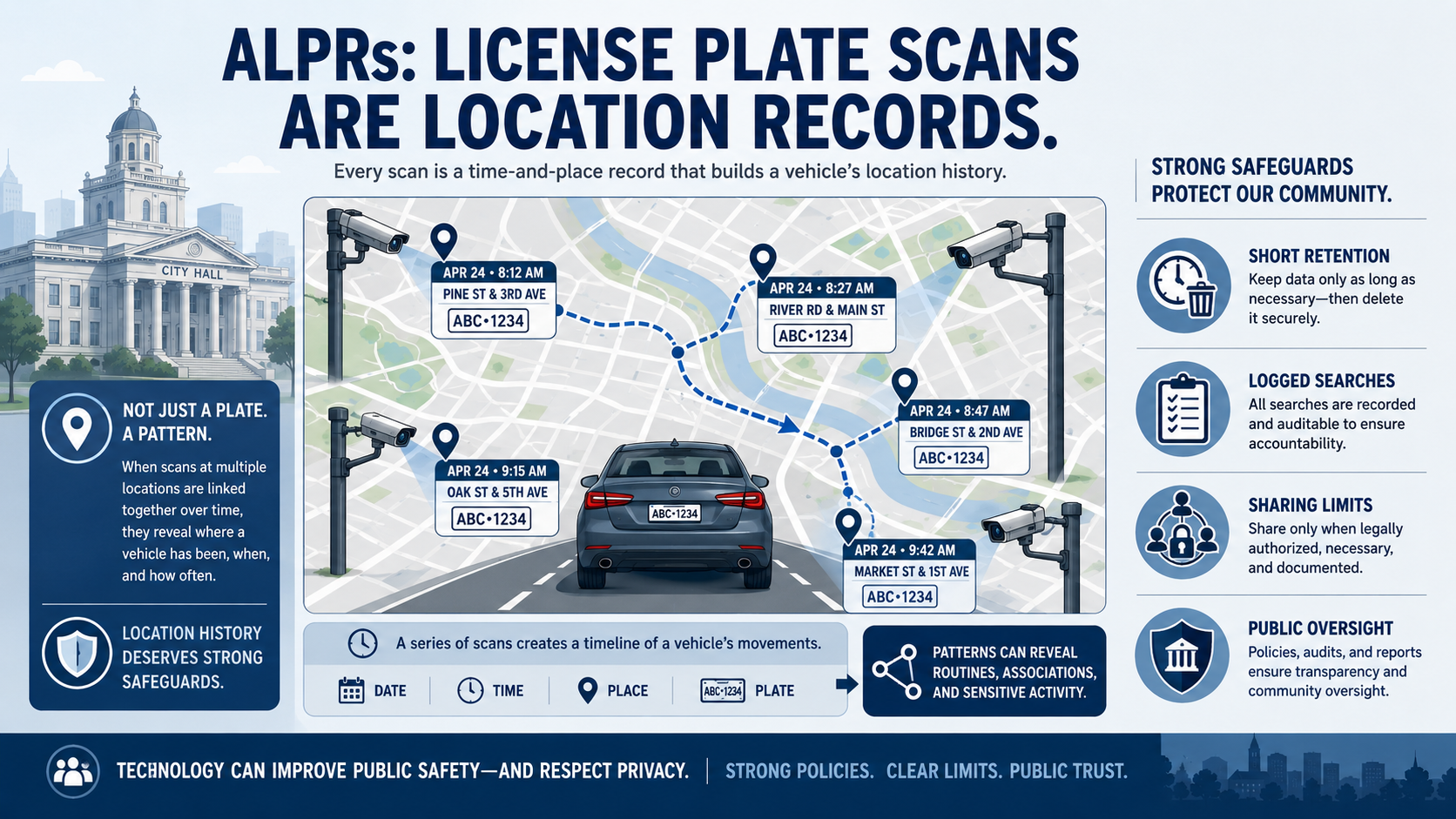
    An automated license plate reader does not just capture a plate number.

    It creates a time-and-place record.

    And when many scans are collected over time, those records can reveal patterns about where a vehicle has been, when it was there, and how often it appeared in certain places.

    That is why ALPR data should be treated as location data.

    It is not “just a plate.”

    It is a record of movement.


    What an ALPR scan actually records

    An ALPR system typically captures:

    • the license plate number,
    • the date and time of the scan,
    • the location of the camera,
    • an image of the plate or vehicle, and sometimes
    • additional metadata about the scan.

    One scan by itself may not say much.

    But multiple scans over time can create a much richer picture.

    If a vehicle is scanned near a home, workplace, school, clinic, place of worship, political event, protest, or support meeting, the scans may reveal sensitive patterns about a person’s life.

    That is why ALPR data deserves careful limits.


    Patterns matter more than single scans

    The privacy issue is not only the plate number.

    The privacy issue is the pattern.

    A series of scans can show where a vehicle travels, how often it visits certain places, what route it takes, when it leaves, when it returns, and whether those movements change over time.

    That is a form of location tracking.

    Even if each individual scan appears routine, the system as a whole can become highly revealing.

    That is why retention periods, search rules, and sharing rules matter so much.


    This post does not claim Bend currently uses fixed ALPR technology

    This post does not claim that Bend currently uses fixed automated license plate reader technology.

    The point is broader: if Bend adopts fixed ALPRs in the future, or if related systems create similar location records, the City should have clear rules in place before deployment.

    Oversight should come first, not later.


    Short retention should be the default

    If ALPR data is retained for long periods, it becomes easier to reconstruct a person’s travel history.

    The longer the data is kept, the more it can be searched, shared, or misused later.

    A reasonable rule would be:

    Delete ALPR scans quickly unless they are tied to a legitimate, documented case.

    I would support a default retention period as short as 72 hours unless the scan is associated with a specific investigative need such as a stolen vehicle, warrant hit, active case, or clearly documented law enforcement purpose.

    That kind of rule allows legitimate use while reducing unnecessary long-term accumulation.


    Every search should be logged

    If ALPR data can be searched, every search should leave a record.

    That record should show:

    • who conducted the search,
    • when it was conducted,
    • what plate or data was searched,
    • the case number or incident number,
    • the reason for the search, and
    • whether the results were shared.

    Without logs, the public has to trust that the system is being used properly.

    With logs, the City can verify that the rules are being followed.


    Sharing should be limited and documented

    ALPR data should not flow freely to outside agencies, vendors, private companies, or federal systems without clear public rules.

    A strong policy would require:

    • a specific legal basis for sharing,
    • a documented case-related purpose,
    • written authorization,
    • an auditable record of what was shared and with whom, and
    • clear limits on bulk or informal access.

    The issue is not whether legitimate case-specific sharing can occur.

    The issue is whether local location data becomes broadly accessible by default.


    Public reports build trust

    If Bend ever uses ALPRs, the City should publish annual public reports showing:

    • how many cameras or systems were used,
    • how many scans were collected,
    • how long data was retained,
    • how many searches were conducted,
    • how many shares occurred,
    • how many outside-agency requests were received,
    • how many requests were granted or denied, and
    • whether any misuse or policy violations were found.

    These reports do not need to expose sensitive investigative details.

    They should provide enough information for residents and elected officials to understand how the system is working.


    The basic principle

    An ALPR scan is not just a plate number.

    It is a location record.

    And location records deserve strong safeguards.

    Short retention. Logged searches. Clear sharing limits. Public oversight.

    Those are not extreme demands.

    They are basic rules for a powerful system.


    Further reading


    Series links

  • ALPR Oversight Is a Democracy Issue

    Signals & Safeguards — A standalone civic-oversight post on license plate readers, public consent, federal access, and the safeguards local governments should require before surveillance networks become hard to unwind.

    ALPR oversight is becoming a democracy issue

    The strongest surveillance story this week is not one camera system by itself. It is the fight over who gets to approve, search, share, and shut down a network once it is already in place.

    Automatic license plate readers, often called ALPRs, are usually introduced as practical public-safety tools. Police agencies point to stolen-vehicle recovery, suspect identification, Amber Alerts, and serious investigations. Those uses can be real. But the democratic problem begins when a system that looks like a set of cameras turns into a searchable movement database shared across agencies, jurisdictions, vendors, and sometimes federal systems.

    That is why the key question is no longer simply, “Do these cameras help police?” The better question is: who controls the system once it exists?

    When public consent breaks down

    In Troy, New York, a dispute over Flock license plate readers escalated after residents objected to cameras installed without meaningful public input, the City Council voted to end the program, and the mayor declared a state of emergency to keep the cameras operating. The fight became larger than Flock: it became a dispute over emergency authority, public consent, and whether elected bodies can still control surveillance systems once public-safety claims are used to preserve them.

    That should concern any community considering ALPRs or similar systems. If ordinary approval channels can be bypassed, delayed, or overridden after cameras are installed, then the public debate happens too late. The technology gains institutional momentum before the rules are settled.

    The democracy issue: surveillance systems should not go live first and receive public rules later.

    Once a camera network is installed, agencies, vendors, and outside partners may develop expectations around continued access. That makes it politically and operationally harder for elected officials to narrow, pause, or end the system.

    The pattern is spreading

    The pattern is appearing elsewhere. In Cleveland and nearby communities, residents and advocates are challenging Flock deployments over privacy, immigration-enforcement access, and uncertainty about who can search the system. In Bend, The Source Weekly reported that federal immigration officials made 279 queries into Bend’s Flock Safety data in the first three weeks after the cameras went live, and Bend Police reportedly did not authorize those searches.

    That Bend example matters because it shows how quickly the debate can move from “Should we install cameras?” to “Who searched the data, why, under what authority, and what did they see?” A local system may be approved for local purposes, but the practical risk is that local vehicle-location data becomes useful to agencies far beyond the community that generated it.

    The federal layer changes the stakes

    The federal layer makes the issue sharper. Reporting from 404 Media says the FBI wants to buy nationwide access to license plate reader data. If local and private cameras can become part of a national movement-search network, then approving a few cameras is not only a local equipment decision. It is a decision about whether local vehicle-location data can become searchable far beyond the community that generated it.

    That does not mean every ALPR deployment is the same, or that every agency intends to misuse the system. It means the rules must be written for the system’s real capabilities, not only for its best-case sales pitch.

    Public safety and public oversight are not opposites

    The public-safety case should not be dismissed. ALPRs can help find stolen vehicles, locate suspects, and respond to serious threats. But that is exactly why governance has to come first. A system useful enough to solve crimes is also useful enough to misuse, over-share, or repurpose.

    Good oversight does not require pretending the technology has no value. It requires acknowledging that useful tools can still create serious risks when access is broad, retention is long, audit logs are weak, vendor permissions are unclear, or outside-agency sharing is treated as a default instead of an exception.

    Why it matters for Bend

    Why it matters for Bend: Bend has already seen how quickly the question can move from “Should we install cameras?” to “Who searched the data, why, and what did they see?” Bend and Redmond are also working through automated traffic-enforcement systems, which are not the same as ALPRs but raise overlapping questions about vendors, retention, access, audit logs, public notice, error correction, and repurposing.

    Traffic cameras, retail ALPRs, police ALPRs, and connected-vehicle data are not identical systems. But they all point toward the same local-governance challenge: ordinary movement is becoming easier to capture, store, search, and share. Communities need clear rules before those records become too convenient to give up.

    “The liberty of every man is at the mercy of every petty officer.”— James Otis, arguing against writs of assistance (1761)

    Safeguards local officials should require

    Before approving, renewing, expanding, or continuing an ALPR program, public officials should require written rules that answer the basic governance questions up front:

    • Purpose limits: define exactly what the system may and may not be used for.
    • Access limits: identify who can search the system and whether outside agencies can access it.
    • Federal-access rules: state whether federal or immigration-enforcement searches are allowed, blocked, or require a specific legal process.
    • Short retention: automatically delete plate data quickly unless it is tied to a documented investigation.
    • Search documentation: require a case number, purpose, user identity, and timestamp for every search.
    • Exportable audit logs: make logs available for independent review, public reporting, and investigation of misuse.
    • Vendor restrictions: define vendor access, support access, data use, training use, subcontractors, and breach obligations.
    • Public reporting: publish regular transparency reports showing searches, outside-agency access, hits, false positives, retention, and policy violations.
    • Democratic review: require council approval before expansion, new integrations, new sharing relationships, or emergency continuation.

    Bottom line: ALPR oversight is becoming a democracy issue because the most important decision is not only whether cameras exist. It is whether the public, through elected officials and enforceable rules, still controls how movement data is searched, shared, retained, audited, and shut down.