Part 5 of the Bend Surveillance Oversight series.
Police reports are not ordinary paperwork.
They can shape criminal charges, court proceedings, plea negotiations, public records, insurance claims, disciplinary reviews, and a person’s ability to defend themselves.
That is why AI-generated police reports deserve careful public oversight.
The issue is not whether officers should use better tools.
The issue is whether official police records remain accurate, reviewable, and auditable when artificial intelligence is involved.
What AI police report tools do
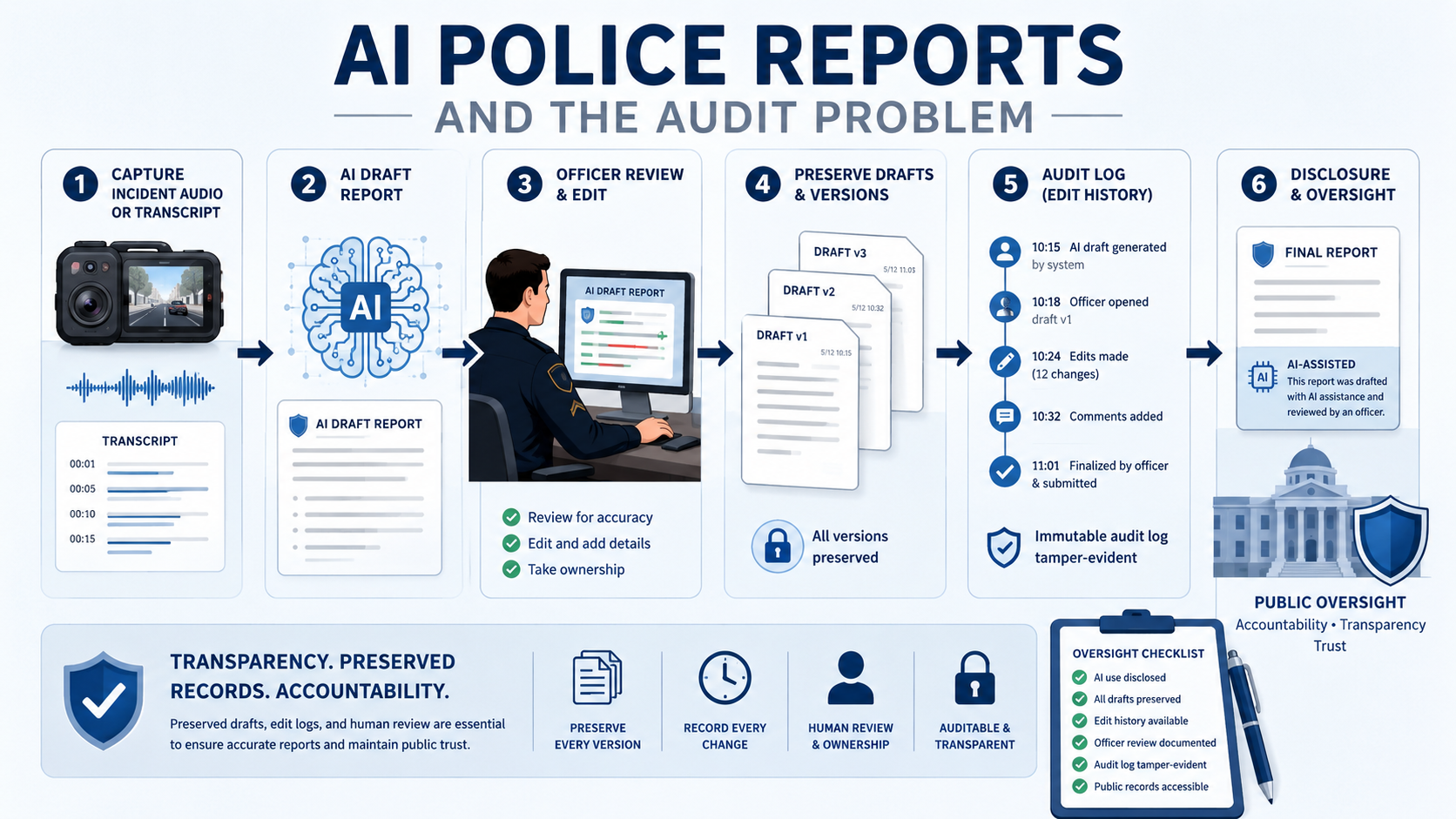
AI police report tools can use body-camera audio, transcripts, officer input, or other records to generate a draft narrative.
That may sound helpful.
Police officers spend a lot of time writing reports, and many departments are looking for tools that reduce paperwork.
But a police report is not just a summary.
It is an official law enforcement record.
If AI helps write that record, the public should know:
- what information the AI used,
- what the AI produced,
- what the officer changed,
- whether the officer verified every factual statement,
- whether the original AI draft was preserved,
- whether errors can be reconstructed later, and
- whether defense attorneys, prosecutors, judges, or oversight bodies can review the process.
Without those safeguards, AI report-writing creates a serious audit problem.
Why the original AI draft matters
Imagine an AI tool creates a draft police report from body-camera audio.
The officer reads it, edits it, and copies the final text into the official report system.
Then the original AI draft disappears.
Later, a defendant, attorney, judge, journalist, auditor, or oversight board wants to know whether a questionable sentence came from the officer, the transcript, or the AI system.
If the original AI draft was not preserved, there may be no way to answer that question.
That is the core problem.
The concern is not only that AI can make mistakes.
The concern is that AI mistakes may become embedded in official records without leaving a trace.
What a basic audit trail should include
A reasonable AI police report policy should require preservation of:
- the original AI-generated draft,
- the body-camera audio or transcript used to generate it,
- the prompt or settings used,
- timestamps,
- the officer’s edits,
- the final submitted report,
- supervisor edits if any, and
- a clear label showing that AI assisted in the drafting process.
This should not be controversial.
If AI saves time and improves accuracy, the audit trail should show that.
If AI introduces errors, the audit trail should make those errors detectable.
Either way, preserving the record protects the public, defendants, officers, prosecutors, and the City.
Bend should set rules before using AI reports
This post does not claim that Bend currently uses AI-assisted police report-writing.
The point is that AI report-writing is already being marketed to law enforcement agencies, and cities should set rules before these tools become routine.
Bend should not wait until after AI-generated police reports become common to decide how they should be governed.
A strong local policy would say:
- No AI-generated police report may be submitted without officer review and certification.
- The original AI-generated draft must be preserved.
- All officer edits must be logged.
- The report must disclose that AI assisted in drafting.
- Prosecutors must be notified when AI was used.
- Defense attorneys must be able to obtain relevant AI drafting records through normal discovery.
- AI report tools may not be used for serious incidents unless additional safeguards are in place.
- The City must publish annual statistics on AI report use, error findings, officer adoption, and measured time savings.
- The vendor may not use Bend data to train AI models without explicit public approval.
- The City must independently audit the system before and after deployment.
These rules would not ban AI.
They would make AI accountable.
No AI-generated police report without an audit trail
Police reports are too important to become black boxes.
If AI helps write an official record, the original AI output should not vanish.
Bend residents should expect a simple rule:
No AI-generated police report without an audit trail.
Further reading
- Axon Draft One product page
- EFF: Axon’s Draft One Is Designed to Defy Transparency
- EFF press release: AI product for police reports designed to hinder audits
- Fair and Just Prosecution: AI-Generated Police Reports — High-Tech, Low Accuracy, Big Risks
- Bend Surveillance Oversight Source Library
Leave a Reply