Jonathan

  • Why Vendor Lock-In Matters in Police Technology Contracts

    Why Vendor Lock-In Matters in Police Technology Contracts

    Part 3 of the Bend Surveillance Oversight series.

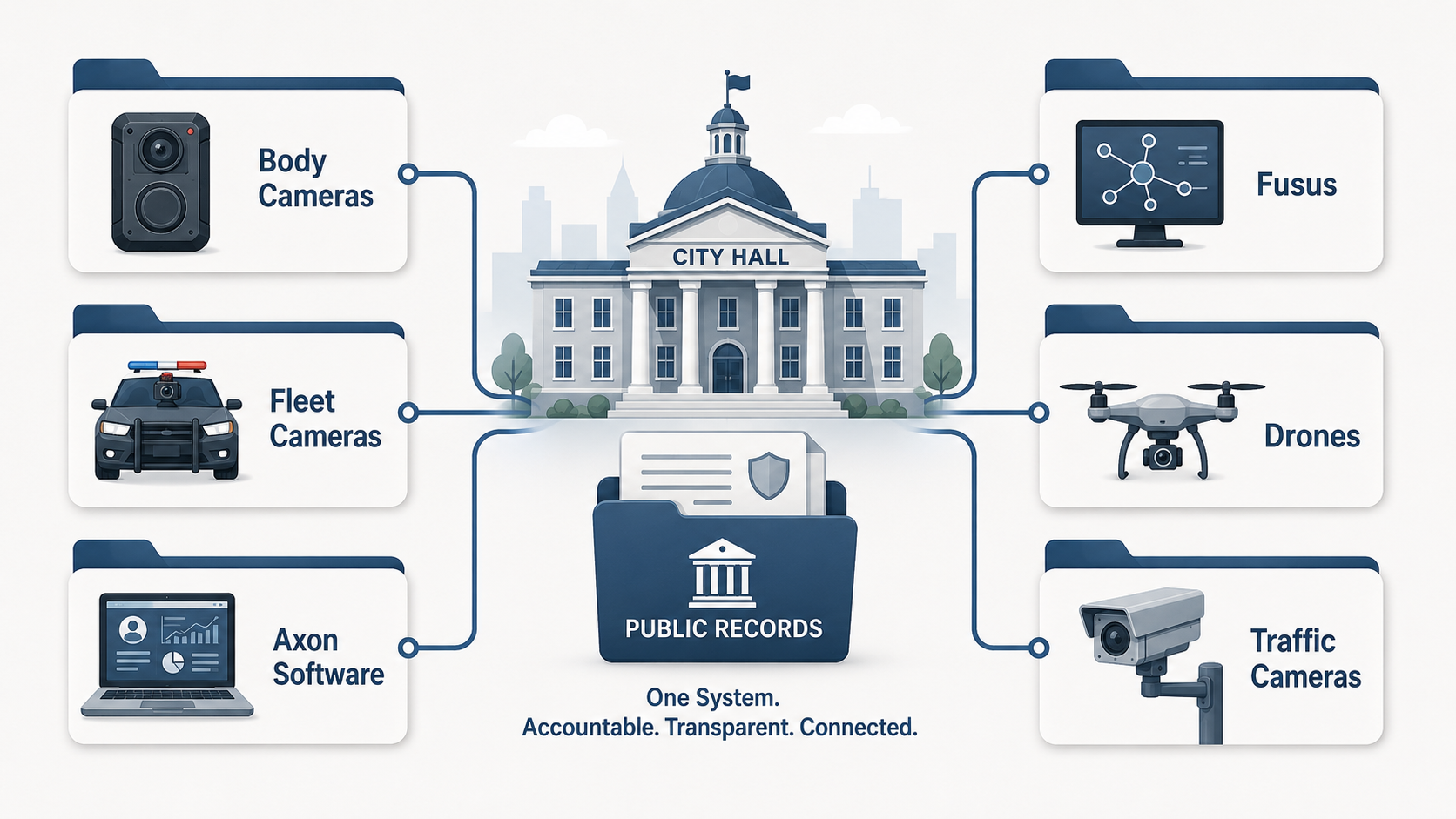
    In the last post, we looked at the range of police technology Bend has already considered, approved, or discussed: body-worn cameras, fleet cameras, digital evidence storage, Fusus real-time information software, Axon Air drone software, third-party video playback, investigation software, VR training, and automated traffic enforcement cameras.

    Looked at one at a time, each purchase can sound narrow.

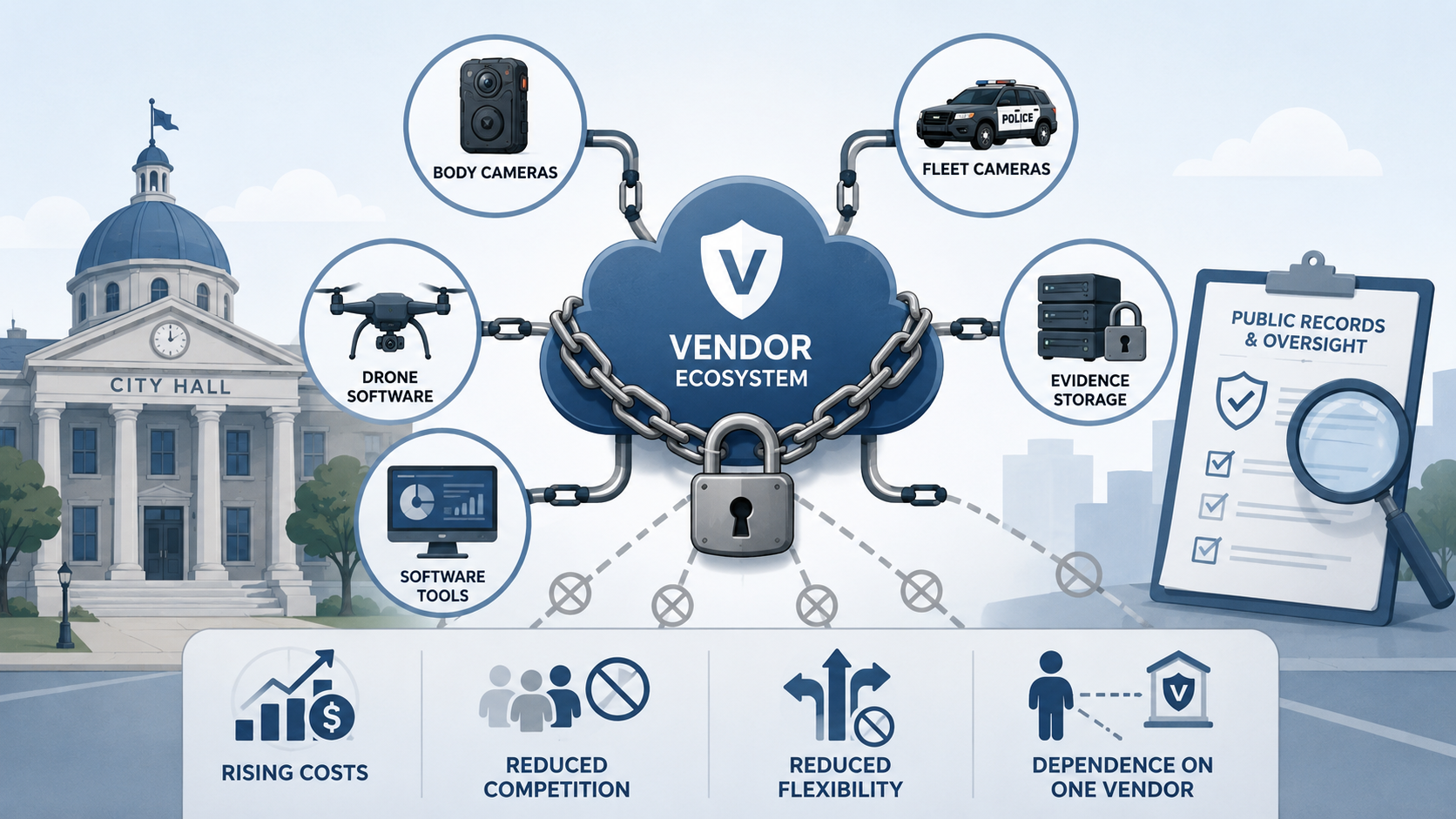
    But when the same vendor ecosystem provides the cameras, storage, software, subscriptions, hardware refreshes, training tools, review tools, and add-on features, the City may gradually become dependent on one platform.

    That is called vendor lock-in.

    Vendor lock-in does not necessarily mean anyone did anything wrong.

    It means a city’s systems, data, workflows, training, contracts, and budgets become so tied to one vendor that switching later becomes expensive, disruptive, or politically difficult.

    That matters for public oversight.


    How lock-in happens

    A city might begin with a legitimate need: body cameras.

    Then it needs a place to store the video, so it adds cloud evidence storage.

    Then prosecutors need access, so the system becomes part of the criminal justice workflow.

    Then patrol vehicles need cameras, so fleet cameras are added.

    Then drone video needs to be managed, so drone software is added.

    Then the department wants video review tools, third-party video playback, investigation software, AI tools, or real-time information platforms.

    Over time, what began as a camera contract can become a broad public safety software ecosystem.

    The Electronic Frontier Foundation has warned about this pattern in its article “Beware the Bundle”, which describes how police technology companies can use bundled offerings to become a department’s default provider for more and more tools.

    Again, the issue is not whether any single tool is useful.

    The issue is whether the public understands how the tools fit together before the City becomes deeply dependent on the platform.


    Why bundled contracts are harder to oversee

    Bundled contracts can make public oversight harder for several reasons.

    First, bundles can obscure what is actually being purchased.

    Second, bundles can make costs harder to compare.

    Third, bundles can reduce practical competition.

    Fourth, bundles can normalize expansion through amendments.

    That is how surveillance systems can grow without residents ever seeing a single clear moment where the full policy question is debated.


    Vendor assurances are not the same as public policy

    Cities often rely on vendor statements about what a system does or does not do.

    That is not enough.

    • Vendors can change product features.
    • Software capabilities can be added later.
    • Terms can change.
    • Subprocessors can be involved.
    • Data can be stored in complex cloud systems.
    • Departments can expand use over time.
    • Future renewals can make earlier decisions harder to revisit.

    That is why public rules should not depend only on vendor assurances or internal department practices.

    Public policy should be clear enough that residents can understand the limits before the next expansion happens.


    Why this matters in Bend

    Bend has already considered or approved multiple related technology systems over time.

    That does not prove a problem by itself.

    But it does show why residents should ask how all of these systems connect, whether alternatives were seriously evaluated, and what would happen if the City later wanted different pricing, stronger privacy protections, or more independent technical control.

    Vendor lock-in is not only a procurement question.

    It is also a transparency and governance question.


    What better contract oversight would look like

    If Bend wants useful technology without becoming overly dependent on one vendor ecosystem, contracts should protect the public interest.

    That can include:

    • clear exit clauses,
    • data portability requirements,
    • limits on automatic renewals,
    • public review before major expansions,
    • independent audits of enabled features and system settings, and
    • Council approval before materially new capabilities are activated.

    Those are not anti-technology ideas.

    They are basic governance safeguards.


    The real question

    The question is not whether Bend should use one vendor or another.

    The question is whether Bend has enough public oversight before the technology ecosystem becomes too large, too expensive, and too embedded to easily change.

    Vendor lock-in is not just a budget issue.

    It is a democracy issue.

    When public safety technology becomes hard to leave, hard to audit, and hard for residents to understand, public oversight becomes weaker.

    That is why Bend should address vendor lock-in now, before future expansions become automatic.


    Further reading


    Series links

  • What Police Technology Has Bend Already Considered or Purchased?

    What Police Technology Has Bend Already Considered or Purchased?

    Part 2 of the Bend Surveillance Oversight series.

    Before Bend residents can have a useful conversation about police surveillance oversight, we need to understand what technology the City has already approved, discussed, or bundled into larger contracts.

    This is not about assuming bad intent.

    It is about making the public record easier to understand.

    Over the past several years, Bend has moved from body-worn cameras into a broader police technology ecosystem involving vehicle cameras, cloud evidence storage, drone software, real-time information tools, third-party video playback, investigation software, and bundled Axon subscriptions.

    That is why this conversation should not be reduced to a simple question like, “Should police have cameras?”

    The better question is:

    What systems has Bend adopted, and what public rules govern the data those systems create?


    Body-worn cameras and Evidence.com

    In April 2021, Bend City Council considered a five-year agreement with Axon for body-worn cameras, associated hardware, analytical software, training, and digital evidence storage, with a contract amount not to exceed $1,038,996.

    The City’s issue summary said full implementation would mean every officer would be equipped with a body-worn camera during their shift, video recordings would be stored, and the Deschutes County District Attorney’s Office would have the ability to receive the information.

    That matters because body cameras are not only recording devices. They also create records that must be stored, accessed, shared, retained, and governed.


    Fleet cameras in police vehicles

    In July 2022, Bend City Council approved a five-year, $679,500 contract with Axon for fleet cameras in Bend Police vehicles.

    The City described the contract as covering purchase and installation of cameras, software, and video storage.

    This is important because fleet cameras can be more than dashboard video. Depending on the hardware, software, and enabled features, vehicle camera systems can interact with evidence storage, metadata, automated review tools, and potentially other software capabilities.

    That is exactly why public policy should focus on capabilities, retention, access, and auditing — not just the word “camera.”


    Fusus real-time information software

    In March 2023, Bend City Council considered a three-year agreement with Fusus Inc. for software and associated hardware to view public and community video sources for incident situational awareness and investigations, with a contract amount not to exceed $230,000.

    The City’s issue summary described Fusus as a real-time crime center platform designed to consolidate video and other information sources.

    It said Fusus could bring together public and private video systems, community tips, community text notifications, Computer Aided Dispatch, unmanned aircraft video, Live 911 information, body-worn cameras, in-car cameras, a community camera registry, a CJIS-compliant video evidence vault, and video live links for 911 callers.

    That is a much broader system than a single camera.

    It is a platform for gathering, viewing, and coordinating multiple information sources in one place.


    Axon Air and drone software

    In February 2024, Bend considered additional Axon Air software licenses for its drone program.

    The issue summary said Bend Police had been using Axon Air software since 2022 for drone support and remote viewing capabilities, and that the department wanted additional pilot and drone licenses.

    It also stated that Bend Police had been using Axon services since 2021 as a unified platform to better track deployment, usage, and results of police actions.

    That phrase — unified platform — is important.

    It shows the direction of travel: not isolated tools, but integration of multiple police technologies into one vendor ecosystem.


    2024 Axon bundled contract

    In October 2024, Bend City Council considered a five-year Axon Officer Safety Plan 10 Premium subscription.

    The meeting minutes state that Council authorized a five-year contract with Axon for Taser hardware, virtual reality hardware and software, digital video recorder playback support, and investigation support software, for a total amount not to exceed $2,555,786.51.

    The minutes also identify the new bundled products and services as Investigate Pro, Third-Party Video Playback, and Virtual Reality training.

    This is the clearest example of why residents need a public inventory.

    Once products are bundled together, it becomes harder for the public to understand which tools are active, which are planned, which are optional, and which could be expanded later.


    Automated traffic enforcement cameras

    Separate from the Axon materials, Bend has also moved forward with automated traffic enforcement.

    The City says the program uses cameras to detect red-light running and speeding at various intersections.

    This is a different type of camera program, but it belongs in the same public conversation because it raises the same basic governance questions:

    • What data is collected?
    • Who operates the system?
    • How long is the data retained?
    • Who can access it?
    • What rules prevent secondary use?

    Why this matters

    Looked at separately, each item may sound narrow:

    • A body camera contract.
    • A fleet camera contract.
    • A drone software license.
    • A real-time information platform.
    • A video playback tool.
    • An investigation software tool.
    • A traffic enforcement camera program.

    But viewed together, they show a larger pattern: Bend is building a police technology environment made of cameras, cloud storage, software subscriptions, vendor platforms, and integrated data systems.

    That does not mean the City should abandon useful tools.

    It does mean residents deserve a clear, public inventory.

    The first step toward meaningful oversight is simple:

    Tell residents what systems exist.


    Selected source documents


    Series links

  • This Is Not Just About Cameras

    This Is Not Just About Cameras

    Part 1 of the Bend Surveillance Oversight series.

    Most people hear “police cameras” and imagine a simple device: a body camera on an officer, a camera in a patrol car, or a license plate reader mounted near a road.

    Cameras are a tool of modern policing, but modern policing was never just about cameras.

    They are often part of a much larger technology ecosystem involving cloud storage, evidence management software, artificial intelligence tools, automated license plate readers, vehicle cameras, drones, real-time crime center platforms, third-party vendors, and future software features that may be added after the original purchase.

    That distinction matters.

    A camera records what happens in front of it. A connected surveillance system can collect data, store it, search it, analyze it, share it, and combine it with other systems. Once that happens, the public policy question changes.

    The question is no longer only:

    Should police have cameras?

    The better question is:

    What rules govern the data those cameras create?

    For example:

    • Where is the data stored?
    • How long is it kept?
    • Who can search it?
    • Are searches logged?
    • Can outside agencies access it?
    • Can vendors access it?
    • Can new AI or biometric features be activated later?
    • Does the City Council have to approve expansions?
    • Are residents told when capabilities change?

    These are not anti-police questions.

    They are basic public oversight questions.

    Body cameras, patrol vehicle cameras, and evidence systems can serve legitimate public safety and accountability purposes. But when those systems are connected to vendor-controlled cloud platforms, AI tools, automated license plate readers, and broader data-sharing networks, the public deserves clear rules before the technology expands.

    This is especially important because cities often start with one tool and later add more tools from the same vendor.

    A city may begin with body cameras, then add fleet cameras, then cloud evidence storage, then license plate readers, then drones, then AI report-writing tools, then real-time crime center software.

    Each step may be presented as a small upgrade.

    But together, those upgrades can create a powerful surveillance infrastructure.

    That is why the issue is not just the camera.

    It is the ecosystem.

    Bend residents should not have to dig through dense procurement packets, legal agreements, and technical appendices to understand what surveillance tools are being used or considered.

    The City should provide a plain-language public inventory of police technology systems, including hardware, software, cloud storage, AI tools, third-party vendors, data retention rules, data-sharing rules, audit procedures, and any future capabilities that can be activated through software.

    This does not require the City to abandon useful technology.

    It simply requires public oversight to keep pace with the technology being purchased.

    Before Bend expands police surveillance systems, residents should be able to answer a simple question:

    Are these tools governed by clear public rules, or are we relying mostly on vendor assurances and internal department policies?

    That is the conversation Bend should have now, before the system becomes larger, more expensive, and harder to change.


    Further reading


    Series links

  • ALPR Oversight Is a Democracy Issue

    Signals & Safeguards — A standalone civic-oversight post on license plate readers, public consent, federal access, and the safeguards local governments should require before surveillance networks become hard to unwind.

    ALPR oversight is becoming a democracy issue

    The strongest surveillance story this week is not one camera system by itself. It is the fight over who gets to approve, search, share, and shut down a network once it is already in place.

    Automatic license plate readers, often called ALPRs, are usually introduced as practical public-safety tools. Police agencies point to stolen-vehicle recovery, suspect identification, Amber Alerts, and serious investigations. Those uses can be real. But the democratic problem begins when a system that looks like a set of cameras turns into a searchable movement database shared across agencies, jurisdictions, vendors, and sometimes federal systems.

    That is why the key question is no longer simply, “Do these cameras help police?” The better question is: who controls the system once it exists?

    When public consent breaks down

    In Troy, New York, a dispute over Flock license plate readers escalated after residents objected to cameras installed without meaningful public input, the City Council voted to end the program, and the mayor declared a state of emergency to keep the cameras operating. The fight became larger than Flock: it became a dispute over emergency authority, public consent, and whether elected bodies can still control surveillance systems once public-safety claims are used to preserve them.

    That should concern any community considering ALPRs or similar systems. If ordinary approval channels can be bypassed, delayed, or overridden after cameras are installed, then the public debate happens too late. The technology gains institutional momentum before the rules are settled.

    The democracy issue: surveillance systems should not go live first and receive public rules later.

    Once a camera network is installed, agencies, vendors, and outside partners may develop expectations around continued access. That makes it politically and operationally harder for elected officials to narrow, pause, or end the system.

    The pattern is spreading

    The pattern is appearing elsewhere. In Cleveland and nearby communities, residents and advocates are challenging Flock deployments over privacy, immigration-enforcement access, and uncertainty about who can search the system. In Bend, The Source Weekly reported that federal immigration officials made 279 queries into Bend’s Flock Safety data in the first three weeks after the cameras went live, and Bend Police reportedly did not authorize those searches.

    That Bend example matters because it shows how quickly the debate can move from “Should we install cameras?” to “Who searched the data, why, under what authority, and what did they see?” A local system may be approved for local purposes, but the practical risk is that local vehicle-location data becomes useful to agencies far beyond the community that generated it.

    The federal layer changes the stakes

    The federal layer makes the issue sharper. Reporting from 404 Media says the FBI wants to buy nationwide access to license plate reader data. If local and private cameras can become part of a national movement-search network, then approving a few cameras is not only a local equipment decision. It is a decision about whether local vehicle-location data can become searchable far beyond the community that generated it.

    That does not mean every ALPR deployment is the same, or that every agency intends to misuse the system. It means the rules must be written for the system’s real capabilities, not only for its best-case sales pitch.

    Public safety and public oversight are not opposites

    The public-safety case should not be dismissed. ALPRs can help find stolen vehicles, locate suspects, and respond to serious threats. But that is exactly why governance has to come first. A system useful enough to solve crimes is also useful enough to misuse, over-share, or repurpose.

    Good oversight does not require pretending the technology has no value. It requires acknowledging that useful tools can still create serious risks when access is broad, retention is long, audit logs are weak, vendor permissions are unclear, or outside-agency sharing is treated as a default instead of an exception.

    Why it matters for Bend

    Why it matters for Bend: Bend has already seen how quickly the question can move from “Should we install cameras?” to “Who searched the data, why, and what did they see?” Bend and Redmond are also working through automated traffic-enforcement systems, which are not the same as ALPRs but raise overlapping questions about vendors, retention, access, audit logs, public notice, error correction, and repurposing.

    Traffic cameras, retail ALPRs, police ALPRs, and connected-vehicle data are not identical systems. But they all point toward the same local-governance challenge: ordinary movement is becoming easier to capture, store, search, and share. Communities need clear rules before those records become too convenient to give up.

    “The liberty of every man is at the mercy of every petty officer.”— James Otis, arguing against writs of assistance (1761)

    Safeguards local officials should require

    Before approving, renewing, expanding, or continuing an ALPR program, public officials should require written rules that answer the basic governance questions up front:

    • Purpose limits: define exactly what the system may and may not be used for.
    • Access limits: identify who can search the system and whether outside agencies can access it.
    • Federal-access rules: state whether federal or immigration-enforcement searches are allowed, blocked, or require a specific legal process.
    • Short retention: automatically delete plate data quickly unless it is tied to a documented investigation.
    • Search documentation: require a case number, purpose, user identity, and timestamp for every search.
    • Exportable audit logs: make logs available for independent review, public reporting, and investigation of misuse.
    • Vendor restrictions: define vendor access, support access, data use, training use, subcontractors, and breach obligations.
    • Public reporting: publish regular transparency reports showing searches, outside-agency access, hits, false positives, retention, and policy violations.
    • Democratic review: require council approval before expansion, new integrations, new sharing relationships, or emergency continuation.

    Bottom line: ALPR oversight is becoming a democracy issue because the most important decision is not only whether cameras exist. It is whether the public, through elected officials and enforceable rules, still controls how movement data is searched, shared, retained, audited, and shut down.

  • Police-Tech Vendors Are Becoming Public-Safety Platforms

    Why platform contracts require ongoing oversight

    Body cameras, TASERs, evidence storage, drones, AI tools, analytics, and report-writing software are increasingly being bundled into long-term public-safety platforms. That changes what local oversight has to look like.

    Core issue: Public agencies are no longer just buying individual police tools. They are often entering long-term platform relationships where today’s contract can shape tomorrow’s data access, AI features, evidence workflows, analytics, storage, integrations, and switching costs.

    Axon is no longer just a TASER and body-camera vendor. Its own Q1 2026 financials show a public-safety platform business built around hardware, software, cloud evidence storage, AI tools, analytics, subscriptions, drones, real-time operations, and long-term agency relationships. Axon reported Q1 2026 revenue of $807 million, up 34% year over year.

    That platform model is showing up in public contracts. Baltimore approved a $153 million Axon agreement for body-worn cameras, TASERs, and other public-safety tools, while some city leaders questioned whether the agreement was the best deal for taxpayers. Savannah approved a 10-year, $27 million Axon agreement. Connecticut State Police rolled out upgraded TASERs, body-worn cameras, AI translation capabilities, VR training, drones, and evidence-management tools as part of a broader modernization package.

    Those examples matter because they show how police technology is becoming a bundle: hardware, cloud storage, evidence systems, report workflows, analytics, AI features, training tools, subscriptions, and future upgrades. The public may hear “body cameras” or “TASERs,” but the contract can also shape data access, retention, search tools, audit logs, and the agency’s ability to leave later.

    Investors have noticed the same shift. Business Insider reported that an Axon pitch at the Sohn conference emphasized AI tools such as automated police-report drafting from body-camera footage. That is a market signal: public-safety data, AI workflows, and subscription platforms are becoming part of the growth story.

    Why the platform model changes oversight

    When a city buys a single device, oversight can focus on that device: what it does, who uses it, and how it is maintained. But a platform is different. A platform can expand over time. New features can be added. Workflows can change. Data can be connected across systems. A contract that starts as a body-camera or TASER purchase can become a broader operational environment for evidence management, report writing, analytics, training, records, drones, and real-time response.

    That does not make every feature harmful. Some tools may improve officer safety, evidence handling, language access, disclosure, or administrative efficiency. But the public needs to understand the tradeoff: each added feature can create new questions about data collection, access permissions, audit logs, retention, vendor access, system dependencies, and whether elected officials will be asked to approve meaningful changes before they happen.

    The safeguard question is not simply “Should the agency buy the tool?” It is also: what future capabilities does this platform make possible, who can enable them, and what public process is required before they are used?

    What local officials should ask before approving or renewing a police-tech platform

    • Feature scope: Which tools are included now, which are disabled, and which can be enabled later without a new public vote?
    • AI and analytics: Are report-writing, transcription, translation, facial recognition, object recognition, predictive analytics, or other AI-assisted tools included or available as add-ons?
    • Data storage: What data enters the vendor’s cloud systems, where is it stored, and how long is it retained?
    • Access controls: Who has administrator access, who can search records, and can access be limited by role, case type, unit, or investigation status?
    • Audit logs: Are searches, views, exports, deletions, administrator changes, and vendor-support access logged in a way the agency can export and review?
    • Vendor access: Can vendor employees access agency data for support, product development, testing, demos, analytics, or AI model improvement?
    • Data sharing: Can outside agencies, task forces, prosecutors, federal agencies, or private partners access the platform or receive exports?
    • Exit rights: If the city leaves the platform, can it export complete evidence records, metadata, audit logs, retention schedules, and chain-of-custody information in a usable format?

    Why it matters for Bend

    Axon-style contracts should be reviewed as evolving governance systems, not static equipment purchases. Council and staff should know which features are enabled, who has administrator access, what data moves into vendor cloud systems, and whether new AI or analytics tools can be added without a fresh public discussion.

    That review should not stop at the purchase vote. A police-tech platform can change through software releases, configuration changes, integrations, add-on modules, and new agency workflows. For major public-safety platforms, the better oversight model is continuing review: regular reporting on enabled features, access settings, audit-log exports, retention changes, vendor access, and any new AI or analytics tools.

    Practical safeguard: Require a quarterly platform change log for major police-tech systems. The log should identify major software releases, enabled or deferred features, AI or analytics tools, search changes, evidence-workflow changes, access-control changes, administrator roles, vendor access, audit-log export capability, retention changes, and new sharing relationships.

    Bottom line

    For public officials, procurement is no longer simply “buying a tool.” It can mean entering a long-term platform relationship where today’s contract shapes tomorrow’s data access, integrations, AI features, analytics, storage, and switching costs. That does not mean cities should reject every new public-safety technology. It means the public rules need to be as durable and adaptable as the technology itself.

    Police technology should be judged not only by what it promises on day one, but by what it allows on day 500: who can search, who can share, who can change the settings, who can audit the system, and who can prove whether the public’s limits were actually followed.

    “No man is allowed to be a judge in his own cause, because his interest would certainly bias his judgment, and, not improbably, corrupt his integrity.”— James Madison, Federalist No. 10 (1787)
  • Signals & Safeguards: Issue 10 – ALPR Oversight, Police-Tech Platforms, and Practical Privacy Safeguards

    Issue 10 • Wednesday, May 20, 2026

    Signals & Safeguards newsletter masthead

    A concise weekly scan of surveillance, privacy, cybersecurity, and the safeguards public officials should keep in view.

    At a glance

    – ALPR oversight is becoming a democracy issue, not just a police-camera issue.

    – Local, private, and federal plate-reader access is turning ordinary movement into searchable infrastructure.

    – Axon’s financials, contracts, and release notes show police technology becoming a changing software-and-data platform.

    – The safeguard question is consistent: who gets access, under what limits, and who can prove misuse?

    ALPR oversight is becoming a democracy issue

    The strongest surveillance story this week is not one camera system by itself. It is the fight over who gets to approve, search, share, and shut down a network once it is already in place.

    In Troy, New York, a dispute over Flock license plate readers escalated after residents objected to cameras installed without meaningful public input, the City Council voted to end the program, and the mayor declared a state of emergency to keep the cameras operating. The fight became larger than Flock: it became a dispute over emergency authority, public consent, and whether elected bodies can still control surveillance systems once public-safety claims are used to preserve them.

    The pattern is appearing elsewhere. In Cleveland and nearby communities, residents and advocates are challenging Flock deployments over privacy, immigration-enforcement access, and uncertainty about who can search the system. In Bend, The Source Weekly reported that federal immigration officials made 279 queries into Bend’s Flock Safety data in the first three weeks after the cameras went live, and Bend Police reportedly did not authorize those searches.

    The federal layer makes the issue sharper. Reporting from 404 Media says the FBI wants to buy nationwide access to license plate reader data. If local and private cameras can become part of a national movement-search network, then approving a few cameras is not only a local equipment decision. It is a decision about whether local vehicle-location data can become searchable far beyond the community that generated it.

    The public-safety case should not be dismissed. ALPRs can help find stolen vehicles, locate suspects, and respond to serious threats. But that is exactly why governance has to come first. A system useful enough to solve crimes is also useful enough to misuse, over-share, or repurpose.

    Why it matters for Bend: Bend has already seen how quickly the question can move from “Should we install cameras?” to “Who searched the data, why, and what did they see?” Bend and Redmond are also working through automated traffic-enforcement systems, which are not the same as ALPRs but raise overlapping questions about vendors, retention, access, audit logs, public notice, error correction, and repurposing.

    The Fourth Amendment line is being tested at the border and at the front door

    Two legal fights point to the same question: when the government intrudes into highly private spaces, do old safeguards still have practical force?

    EFF is urging the Fourth Circuit to require warrants for electronic-device searches at the border. Phones and laptops are not ordinary containers. They hold messages, photos, location trails, health information, financial records, work files, source communications, family details, and years of private life. A border search of a phone can reveal far more than a search of luggage.

    The same principle appears in the home-entry context. Lawfare has criticized DHS’s defense of immigration home entries based on administrative warrants, arguing that an administrative document issued inside the enforcement system is not the same as a judicial warrant signed by a neutral judge. That distinction matters because the home has long received the strongest Fourth Amendment protection.

    The point is not that the government can never search a device, enter a home, or enforce immigration law. The point is that process matters most when the stakes are high. A real warrant requirement forces the government to state facts, define the scope, and persuade a neutral decision-maker before the intrusion happens.

    Why it matters for Bend: federal privacy norms shape the environment local governments operate in. If device searches, home entries, database queries, and surveillance partnerships become easier at the federal level, local officials should be more careful about importing low-friction access into city systems, vendor contracts, and data-sharing agreements.

    Immigration surveillance vendors need verification before deployment

    Immigration enforcement is increasingly tied to vendor systems, mobile access, and large searchable databases. That makes vendor verification a civil-liberties safeguard, not a procurement formality.

    The Lever reported on Edge Ops, an ICE surveillance vendor connected to a system described as mapping immigrants’ routines and locations. The reporting raised basic due-diligence questions about the company’s public claims, executives, clients, and marketing materials. Separately, 404 Media reported that ICE agents have access to a large list of people on their phones through Palantir-linked systems.

    The concern is not only what data exists. It is how easily that data becomes available in the field. Mobile access changes the meaning of a database. If agents can carry searchable identity, address, location, case, or association information on a phone, the public needs to know who can search it, what legal threshold applies, whether searches are logged, whether results can be shared, and how errors are corrected.

    This is the same access problem that appears in ALPR systems. Surveillance oversight is often less about the sensor and more about the database behind it. Who can search? Who can export? Who can share? Who audits? Who can prove misuse?

    Why it matters for Bend: Bend residents’ information may pass through city, county, state, vendor, and federal systems. A privacy rule or sanctuary policy only works if the database permissions behind it match the public promise.

    Shared pattern

    The strongest stories this week point to the same lesson: access is the real policy.

    A camera is not just a camera if its records can be searched by outside agencies. A body camera is not just a body camera if its footage feeds a cloud platform, AI report-writing tools, evidence workflows, and long-term data storage. A phone is not just a device if it contains years of private life. A database is not just a database if field agents can query it from an app. A data center is not just a building if it reshapes local power, water, land-use, and infrastructure decisions.

    The safeguard question is consistent across all of them: who gets access, under what authority, with what limits, with what logs, and with what public ability to review the answer?

    “The liberty of every man is at the mercy of every petty officer.”— James Otis, arguing against writs of assistance (1761)

    Police-tech vendors are becoming public-safety platforms

    Axon is no longer just a TASER and body-camera vendor. Its own Q1 2026 financials show a public-safety platform business built around hardware, software, cloud evidence storage, AI tools, analytics, subscriptions, drones, real-time operations, and long-term agency relationships. Axon reported Q1 2026 revenue of $807 million, up 34% year over year.

    That platform model is showing up in public contracts. Baltimore approved a $153 million Axon agreement for body-worn cameras, TASERs, and other public-safety tools, while some city leaders questioned whether the agreement was the best deal for taxpayers. Savannah approved a 10-year, $27 million Axon agreement. Connecticut State Police rolled out upgraded TASERs, body-worn cameras, AI translation capabilities, VR training, drones, and evidence-management tools as part of a broader modernization package.

    Those examples matter because they show how police technology is becoming a bundle: hardware, cloud storage, evidence systems, report workflows, analytics, AI features, training tools, subscriptions, and future upgrades. The public may hear “body cameras” or “TASERs,” but the contract can also shape data access, retention, search tools, audit logs, and the agency’s ability to leave later.

    Investors have noticed the same shift. Business Insider reported that an Axon pitch at the Sohn conference emphasized AI tools such as automated police-report drafting from body-camera footage. That is a market signal: public-safety data, AI workflows, and subscription platforms are becoming part of the growth story.

    For public officials, procurement is no longer simply “buying a tool.” It can mean entering a long-term platform relationship where today’s contract shapes tomorrow’s data access, integrations, AI features, analytics, storage, and switching costs. That does not make every feature harmful, but it does mean elected oversight has to continue after the purchase vote.

    Why it matters for Bend: Axon-style contracts should be reviewed as evolving governance systems, not static equipment purchases. Council and staff should know which features are enabled, who has administrator access, what data moves into vendor cloud systems, and whether new AI or analytics tools can be added without a fresh public discussion.

    Warning Signals

    These items point toward where surveillance systems, vendor platforms, identity infrastructure, and data governance may be heading next.

    Signals section header

    Platform Watch: Axon software updates show why oversight cannot stop at purchase

    Axon’s May 2026 Records and Standards release notes show how a police-technology platform can change after a contract is approved. The May 19 rollout touches report writing, embedded photos, Evidence links, search behavior, audit-log display, chain-of-custody records, property labels, mobile notes, and DataStore access controls.

    Some changes may improve clarity or accountability. Axon says users will be able to insert photos directly into report narrative text across both Records and Standards in training environments. The embedded photos appear as thumbnails and link back to the Evidence details page in Axon Evidence.

    The strongest accountability item is DataStore v2 row-level access control. Axon says agencies previously used custom views to share DataStore access while protecting sensitive records such as Internal Affairs files, juvenile records, ongoing investigations, and restricted content. The new preview feature lets administrators exclude rows a user is not authorized to see, but restriction enforcement is off by default and must be enabled by administrators.

    Oversight question: Does the agency provide Council with a quarterly platform change log showing major software releases, enabled features, administrator settings, audit-log exports, DataStore access, vendor access, and any new AI, analytics, evidence, search, or access-control tools?

    Movement data is escaping public categories

    ALPRs are moving from city streets into ordinary consumer spaces. Reporting on Lowe’s and Home Depot shows how retailers can use license plate readers in parking lots for theft prevention and safety. Connecticut lawmakers have moved to restrict some police ALPR sharing, but those rules do not cover private retailers.

    Connected cars raise the same concern from another direction. The Guardian reported that General Motors agreed to pay $12.75 million to settle California claims that it sold drivers’ location and driving-behavior data to data brokers without proper consent. The point is not that cars, stores, or cameras are identical systems. The point is that each can create movement records outside the categories people usually associate with government surveillance.

    Traffic cameras add a local wrinkle. Bend and Redmond are working through automated traffic enforcement. Traffic cameras are not the same as Flock or retail ALPRs, but the governance questions overlap: retention, access, vendor contracts, audit logs, public notice, error correction, and whether data collected for one purpose can later be repurposed.

    Data-center infrastructure is becoming a local consent fight

    Data centers are no longer an abstract technology story. They are becoming local governance questions about power, water, land use, jobs, taxes, infrastructure costs, emergency services, and public trust.

    La Pine residents have raised concerns about a proposed data-center project connected to BoxMiner, and the City of La Pine has published a release summarizing what has come before Council. Central Oregon coverage shows the concern is not only whether a project is legal. It is whether residents understand the long-term costs, commitments, and infrastructure consequences before decisions are effectively locked in.

    National polling suggests this concern is not unique to Central Oregon. Gallup reported broad public opposition to AI data centers in respondents’ local areas. The best framing is not “no data centers.” It is “public-infrastructure decisions need public-infrastructure scrutiny.”

    AI is shortening the distance between flaw and exploit

    Google says it disrupted a hacking operation that used AI to help discover and exploit a previously unknown vulnerability. AP, Reuters, Axios, and The Hacker News all covered versions of the same warning: AI can help attackers move faster from finding a weakness to testing and deploying an exploit.

    The week’s other cybersecurity stories reinforce the same practical lesson. Microsoft patched 138 vulnerabilities. CISA added a newly exploited vulnerability to its Known Exploited Vulnerabilities catalog. A WooCommerce Funnel Builder flaw was reportedly under active exploitation. Krebs reported that a CISA contractor exposed AWS GovCloud credentials in a public GitHub repository.

    The safeguard is boring but urgent: inventory exposed systems, patch actively exploited flaws first, remove unsupported devices, use phishing-resistant MFA, scan code repositories for secrets, rotate exposed credentials quickly, and require vendors to disclose patch and incident timelines.

    “In questions of power, then, let no more be heard of confidence in man, but bind him down from mischief by the chains of the Constitution.”— Thomas Jefferson, Kentucky Resolutions draft (1798)

    Safeguards

    Safeguards works best when they’re practical: less data, cleaner boundaries, stronger access controls, usable audit logs, and fewer shortcuts.

    Safeguards section header

    Require public rules before deployment or emergency continuation

    Camera systems, ALPR networks, drones, ShotSpotter-style tools, and police-tech platforms should not go live first and receive rules later.

    Public rules should answer basic questions before deployment: what data is collected, how long it is retained, who can search it, whether outside agencies can access it, whether federal or immigration-enforcement access is allowed, whether vendor employees can access it, whether searches require case numbers or documented purposes, whether audit logs are exportable, and how misuse is punished.

    Emergency authority deserves special care. If an emergency declaration is used to preserve or expand a surveillance system after ordinary political approval breaks down, the declaration should be narrow, time-limited, publicly justified, and subject to prompt council review.

    Treat police-tech contracts as governance documents

    A police-technology contract is not just a purchase order. It can define data access, AI features, evidence storage, audit logs, vendor permissions, integrations, renewal leverage, and exit costs for years.

    Before approving or renewing a platform contract, public officials should ask what the contract makes possible later. What AI tools can be added? Where is the data stored? Who can access it? Can the vendor use agency data for training, product development, support, demos, or analytics? What outside agencies can search the system? What records are retained after termination? Can the agency export complete audit logs and evidence records if it leaves?

    Require quarterly platform change logs

    For major police-tech and public-data systems, agencies should provide Council with a short quarterly change log covering major software releases, enabled or deferred features, AI or analytics tools, search changes, evidence-workflow changes, access-control changes, administrator roles, vendor access, DataStore or reporting access, audit-log export capability, retention changes, and new sharing relationships.

    This is not anti-technology. It is basic oversight for systems that do not stay frozen after purchase.

    Make warrants and notice real

    A warrant requirement only works if the warrant process is real. Courts need specific facts, narrow scope, and neutral review before high-intrusion searches. That matters for border-device searches, home entries, geofence searches, cloud records, account data, and sensitive databases.

    Notice also matters. H.R.6048, the NDO Fairness Act, is worth tracking because people cannot challenge improper electronic searches if they never learn the search happened. Delayed notice may be justified in some investigations, but secrecy should be narrow, time-limited, and based on specific facts.

    Treat movement and biometric data as high-risk data

    Vehicle telematics, retail ALPRs, hotel reservations, phone location, connected devices, school platforms, and traffic-camera systems can reveal where people live, work, worship, seek care, shop, protest, attend school, or travel. Biometric data raises even greater stakes because faces, fingerprints, and palm prints cannot be reset like passwords.

    The NYC Health + Hospitals breach is a reminder that biometric and medical data create permanent risk when exposed. Public agencies and vendors should collect less biometric data, store it separately when collection is necessary, encrypt it, limit access, shorten retention, document every search, and provide clear breach notice and deletion rules.

    Judge privacy bills by what they prevent, not what they promise

    A weak privacy bill can give people familiar rights – access, correction, deletion, portability, or opt-outs – while still allowing broad data collection, weak default protections, preemption of stronger state laws, limited enforcement, or loopholes for data brokers and sensitive data. A serious privacy law should reduce unnecessary collection, preserve stronger state protections, regulate data brokers, protect sensitive data by default, create usable deletion and correction processes, and provide real enforcement.

    Bottom line

    The best safeguards this week are not exotic. They are the boring controls that make powerful systems governable: public rules before deployment, narrow access, clear warrants, meaningful notice, exportable audit logs, short retention, vendor verification, platform change logs, data minimization, and fast patching. Surveillance oversight works best when restraint is built into the system before the data becomes too useful to give up.

    “No man is allowed to be a judge in his own cause, because his interest would certainly bias his judgment, and, not improbably, corrupt his integrity.”— James Madison, Federalist No. 10 (1787)
  • What Happens Next: Stopping the Boxminer Data Center Deal

    Advocate Road Map · La Pine, Oregon · Issued May 14, 2026

    The process that must occur before any sale is final, the community’s intervention points, and actions to take this week.


    ⚠ Important: The May 13, 2026 public comments were not a legal public hearing. Oregon law requires a formal public hearing before this sale can close.

    Nearly three hours of public opposition were delivered at the May 13, 2026 La Pine City Council meeting. That is significant — but the fight is far from over, and the community has more legal leverage than it may realize.

    Oregon law mandates a formal public hearing before any city-owned land can be sold. That has not happened yet. Every step below must occur before Boxminer can legally take ownership of this property. Each one is an intervention point.

    The Foundational Law: ORS 221.725

    Oregon law is unambiguous: before a city council can sell city-owned real property, it must publish advance notice of the proposed sale in a newspaper of general circulation and hold a formal public hearing prior to the sale.

    At that hearing, the full nature and terms of the sale — including an independent appraisal or other evidence of market value — must be fully disclosed. Any city resident has the right to submit written or oral testimony.

    The May 13 public comment period does not satisfy this requirement. The March 25 vote to begin the purchase-and-sale process does not satisfy this requirement.

    The ORS 221.725 public hearing has not been held. The sale cannot legally close until it is.


    Part One: The Process Map — What Must Happen Before the Sale Can Close

    1. ORS 221.725 Public Hearing — Legally Required, Has Not Occurred

    Legal basis: Oregon Revised Statutes § 221.725 · City of La Pine

    Primary intervention point · Legally mandatory

    The city must publish a formal notice of the proposed sale in the Bend Bulletin, the newspaper of general circulation for La Pine. The notice must state the time and place of the hearing, a full description of the property, the proposed uses, and the reasons for the sale.

    Not earlier than five days after that publication, the council must hold the public hearing. At the hearing, the full sale terms — including an independent appraisal or other evidence of market value — must be publicly disclosed. Any city resident must be given the opportunity to submit written or oral testimony.

    What advocates can do: Demand in writing that the city confirm it will comply with ORS 221.725 and provide the date of the required publication. This is not a request — it is a statement that the community knows its rights.

    2. Full Contract Disclosure at Public Hearing

    Legal basis: Oregon Revised Statutes § 221.725 · Appraisal requirement

    Intervention point · Legally mandatory

    At the ORS 221.725 hearing, the city is legally required to fully disclose the nature and terms of the proposed sale, including an independent appraisal or equivalent evidence of market value. This means the full purchase and sale agreement — including any growth or expansion provisions — must be on the public record before the council votes.

    What advocates can do: File a Public Records Request now, before the hearing, for the full PSA text, all communications between city staff or council members and Boxminer, any appraisal commissioned, and any MidState Electric correspondence. The city has five business days to respond or provide a timeline under ORS 192.311.

    3. City Council Vote to Approve the Purchase and Sale Agreement

    Public body: La Pine City Council · Public agenda item

    Intervention point

    This is a separate vote from the March 25 vote to begin the process. The council must vote to formally approve the finalized PSA. This vote must appear on a public agenda with advance notice, giving advocates another opportunity to submit written testimony and speak during public comment.

    What advocates can do: Monitor the city’s meetings page at lapineoregon.gov/meetings for agenda postings. The next regular meeting is May 27, 2026. Any PSA approval vote must be listed as a new business item with supporting documents in the packet. If it appears without prior public notice of the ORS 221.725 hearing, challenge it immediately in writing.

    4. Deschutes County Deed Transfer — County Publication Required

    Legal basis: Oregon Revised Statutes § 275.120 · Deschutes County Board of Commissioners

    County action required · Intervention point

    The land is currently owned by Deschutes County. Before the county can transfer title, Oregon law requires the county sheriff to publish a notice of the sale in a local newspaper of general circulation once per week for four consecutive weeks prior to the sale. This is a parallel, independent publication requirement that creates another four-week public notice window.

    What advocates can do: Contact the Deschutes County Board of Commissioners now and put them on record. As the current titleholder, the county is a party to this transaction. Submit written testimony to the BOCC and request that the county independently verify the city has completed its ORS 221.725 obligations before proceeding.

    5. Formal Land Use Application and Site Plan Review — Planning Commission

    Legal basis: La Pine Development Code · City Planning Commission · ORS 227.178

    Second major intervention point

    Even after the land sells, Boxminer cannot break ground without submitting a formal land use application for site plan review. This triggers La Pine’s Planning Commission process, which has its own public notice, comment period, and hearing requirements completely independent of the land sale process.

    This is where the zoning question must be formally resolved in writing by city staff: La Pine Development Code Sec. 15.24.300 states that in the Light Industrial zone, “Energy and power generation uses are prohibited.” City staff must publish a written legal determination explaining how a 20MW Bitcoin mining facility is classified under that code before any permit can issue.

    What advocates can do: Central Oregon LandWatch can formally intervene in the land use process when the application is filed and can refer legal counsel to challenge the zoning classification if needed. File a written request with city Community Development now asking staff to confirm in writing the zoning classification that would apply to this use before an application is filed.

    6. Building Permits Issued — Final Gate

    Public bodies: La Pine Building Services · Deschutes County Community Development

    Final gate

    Building permits cannot be issued until after land use approval. Each permit is a public record. If the zoning determination or site plan review is contested, a Land Use Board of Appeals appeal can be filed, which can put a hold on permit issuance while the appeal is heard.

    The Oregon Department of Land Conservation and Development also has oversight authority over local land use decisions that conflict with acknowledged comprehensive plans.


    Part Two: What Advocates Should Do This Week

    🔥 Send a Written ORS 221.725 Demand Letter to City Hall

    Timing: Do within 48 hours.

    Write to City Manager Geoff Wullschlager and the City Recorder demanding:

    • Written confirmation that the city will comply with ORS 221.725 before finalizing any sale.
    • The anticipated date of the required newspaper publication.
    • Confirmation that the ORS 221.725 public hearing will be separately noticed and held before any PSA vote.

    Send by email and certified mail. Keep a copy. This letter creates a paper trail that the city received formal notice of its obligations.

    City Manager: Geoff Wullschlager
    Email: info@lapineoregon.gov
    Phone: (541) 536-1432
    Address: 16345 Sixth Street, La Pine, OR 97739

    🔥 File a Public Records Request for the Full Contract and All Communications

    Timing: Do within 48 hours.

    Under ORS 192.311, the city has five business days to provide the records or give a timeline. Request:

    • The full text of any purchase and sale agreement, letter of intent, or MOU with Boxminer Co. or any related entity.
    • All written communications between city staff or council members and Boxminer Co., Frontier Mining, or Jeff Keller from January 2025 to present.
    • Any appraisal of the subject property.
    • Any MidState Electric correspondence regarding power supply.
    • Any legal opinion on the Light Industrial zoning classification of this use.

    File online: La Pine Public Records Request Form

    🔥 Call Central Oregon LandWatch

    Timing: Do within 48 hours.

    Rory Isbell at Central Oregon LandWatch was previously unaware of this proposal. He now is, but he needs to hear that nearly three hours of public opposition materialized at the May 13 council meeting and that the ORS 221.725 hearing has not been scheduled.

    Share this key fact from the March 11 minutes: Jeff Keller told the council he had been working with MidState Electric and SLED Director Patricia Lucas since 2022 — three years of negotiations before the public heard a word. That timeline is material to any legal challenge about adequate public process.

    LandWatch can provide or refer an attorney to formally intervene at both the public hearing and the Planning Commission site plan review stage.

    Contact: Rory Isbell, Staff Attorney and Rural Lands Program Director
    Email: rory@colw.org
    Phone: (541) 647-2930 x804

    📋 Document the May 13 Comments While They Are Fresh

    Timing: Do within 72 hours.

    The nearly three hours of public comments are part of the official record, but advocates should independently document them. Track the names and addresses of speakers, the specific concerns raised, and any commitments or statements made by council members or city staff in response.

    This record will be essential at the ORS 221.725 formal hearing and any future LUBA appeal. If anyone recorded the meeting, secure those recordings now. The city should also produce audio or video if it exists; request it via public records if needed.

    📋 Write to the Deschutes County Board of Commissioners

    Timing: Do this week.

    The county is the current landowner and must execute the deed transfer. The city itself has publicly confirmed that Deschutes County must sign off on the final land sale and that a county building review is also required before construction.

    This means the BOCC has real authority here — not just a rubber stamp role. Write to the BOCC formally:

    • Notify them that significant organized community opposition exists.
    • Request that the county independently confirm the city has completed its ORS 221.725 obligations before proceeding with any transfer.
    • Ask the BOCC to place the matter on a public agenda for discussion.

    Deschutes County Board of Commissioners:
    deschutes.org
    1300 NW Wall Street, Bend, OR 97703

    🔥 Request a Speaking Slot at the May 29 Oregon Data Center Advisory Committee Meeting</h3

  • Surveillance • Privacy • Local Oversight

    Bend’s Flock Data Shows Why Surveillance Oversight Must Be Built Into the System

    Recent reporting about Bend’s Flock Safety cameras and Oregon’s sanctuary-law lawsuit point to the same lesson: privacy rules only work when the databases enforce them.

    The most important surveillance story in Bend this week is not hypothetical. According to The Source Weekly, federal immigration officials made 279 queries into Bend’s Flock Safety data in the first three weeks after the cameras went live. Bend Police reportedly did not authorize those searches, and it remained unclear what, if any, data may have been retrieved.

    That should concern anyone who cares about local control, public accountability, or civil liberties.

    The issue is not simply whether a particular search was improper. The larger problem is governance. When a surveillance system is installed for one stated purpose, it can quickly become useful to other agencies, vendors, or outside users who were not central to the original public debate.

    If city officials cannot later answer basic questions — who searched the system, why they searched it, what they saw, whether the search was tied to a case number or documented purpose, and whether any result was shared — then the public is being asked to trust a system that cannot be independently verified.

    That is not meaningful oversight. That is a blind spot.

    Audit logs are not a technical detail. They are the oversight system.

    Surveillance oversight often gets discussed as if it is mainly a policy question: Should the city approve the tool? What is the stated purpose? What does the vendor promise? What does the agency say it intends to do?

    Those questions matter, but they are not enough.

    Once a system is live, the real questions become operational:

    • Who can access the system?
    • Can outside agencies search it?
    • Can federal agencies search it?
    • Can vendors access camera feeds, search tools, dashboards, support logs, or stored data?
    • Does every search leave a usable record?
    • Can elected officials or independent reviewers verify how the system was used?
    • Are searches tied to a case number, warrant, emergency, or documented purpose?
    • Are improper searches detectable?

    Without those controls, the public has no practical way to know whether the system is being used as promised.

    This does not require assuming bad faith by local officials. In fact, it shows why good-faith intentions are not enough. A system can be approved by people with narrow intentions and later become available to people with very different priorities. That is why access controls, audit logs, outside-agency limits, vendor-access limits, and public reporting must exist before a system goes live.

    “You must first enable the government to control the governed; and in the next place oblige it to control itself.”
    — James Madison, The Federalist No. 51 (1788)

    Oregon’s sanctuary-law lawsuit is also about database access

    The Bend Flock story now sits inside a larger Oregon data-sharing dispute.

    OPB reported that a lawsuit filed in Multnomah County Circuit Court alleges Oregon State Police allowed federal immigration authorities to access Oregonians’ data through shared law-enforcement databases for years, despite Oregon’s sanctuary laws. Oregon State Police denies wrongdoing.

    The Source Weekly also reported that the complaint alleges federal immigration authorities queried state-run data about Oregonians 1.4 million times between February 2025 and February 2026, an average of 3,835 queries each day.

    The practical lesson is straightforward: a sanctuary policy is only as strong as the database permissions behind it.

    If an agency is legally barred from using data for immigration enforcement, the system should not rely on informal restraint. It should include technical controls that prevent improper access, audit logs that expose improper use, and consequences when policy and practice diverge.

    A privacy rule that lives only on paper is fragile. A privacy rule built into permissions, logging, retention limits, and reporting is much harder to ignore.

    Why this matters for Bend

    Bend residents’ information may pass through city, county, state, vendor, and law-enforcement systems. That information can include license plate scans, police records, driver information, public records, utility records, permits, emergency-service data, and other civic information collected for ordinary public purposes.

    The danger is that data collected for one purpose can become useful for another.

    A license plate reader approved for local public-safety purposes can become searchable by outside agencies. A state database can become an immigration-enforcement tool. A vendor platform can create access points that city officials did not fully understand when the contract was approved. A policy promise can fail if the technology underneath it does not actually enforce the rule.

    That is why surveillance oversight cannot stop at approval. Local officials need to know who can search local systems, what outside agencies can access, what vendors can see, how long data is retained, and whether every search leaves a record that can be reviewed.

    The safeguard standard should be simple

    Before Bend approves, renews, or expands any surveillance or sensitive data system, the city should be able to answer:

    • Who can access the data?
    • Who can search the system?
    • Can outside agencies access it?
    • Can federal agencies access it?
    • Can vendors access it?
    • Is every search logged?
    • Are searches tied to a documented purpose?
    • How long is data retained?
    • Can improper access be detected?
    • Can elected officials and the public receive meaningful reports about system use?

    If those questions cannot be answered clearly, the system is not ready.

    This is not about being anti-technology. It is about making sure public technology remains accountable to the public. Tools that collect sensitive information should not depend on trust alone. They should be designed so that misuse is difficult, detectable, and provable.

    Bottom line

    The Bend Flock story and the Oregon sanctuary-law lawsuit point to the same conclusion: access is the story.

    Who can search the data? Who can receive it? Who can share it? Who can buy it? Who can combine it with other systems? Who can turn an ordinary resident’s movement, record, or routine interaction with government into an investigative lead?

    Privacy safeguards fail when access is undefined, unlogged, or routed through systems the public cannot see.

    The best safeguards are practical and boring by design: collect less data, connect fewer systems, limit outside access, require documented purposes, log every search, review the logs, shorten retention, make vendor access visible, and make misuse provable.

    Surveillance oversight works best when restraint is built into the system before the data becomes too useful to give up.


    Related reading:

  • Signals & Safeguards – Issue 9

    Issue 9 • Wednesday, May 13, 2026

    Signals & Safeguards newsletter masthead

    A concise weekly scan of surveillance, privacy, cybersecurity, and the safeguards public officials should keep in view.

    At a glance

    • Bend’s Flock experience shows why outside access and audit logs are not technical details. They are the oversight system.
    • Oregon’s sanctuary-law lawsuit shows that privacy rules must be enforceable at the database level, not just written into policy.
    • Location data, DMV records, platform data, and biometrics are becoming immigration-enforcement inputs.
    • Courts and lawmakers are beginning to test whether digital searches need stronger limits.

    Bend’s Flock data shows why audit logs are not optional

    The strongest local surveillance story this week is not hypothetical. According to The Source Weekly, federal immigration officials made 279 queries into Bend’s Flock Safety data in the first three weeks after the cameras went live. Bend Police did not authorize those searches, and the reporting says it was unclear what, if any, data may have been retrieved.

    That is the core governance problem. A surveillance system can be installed for one stated purpose, then become useful to agencies, vendors, or outside users who were not central to the original public debate. If officials cannot later answer who searched the system, why they searched it, what they saw, and whether the results were shared, then the public is being asked to trust a system that cannot be independently verified.

    This does not require assuming bad faith by local officials. It shows why good-faith intentions are not enough. Access controls, audit logs, outside-agency limits, vendor-access limits, and public reporting have to exist before a system goes live.

    Why it matters for Bend: Bend’s own experience shows that surveillance oversight cannot stop at approval. Councilors and staff need to know who can search local systems, what outside agencies can access, what vendors can see, and whether every search leaves a usable record.

    Oregon’s sanctuary-law fight is also a database-access fight

    The Bend Flock story now sits inside a larger Oregon data-sharing dispute. OPB reports that a lawsuit filed in Multnomah County Circuit Court alleges Oregon State Police allowed federal immigration authorities to access Oregonians’ data through shared law-enforcement databases for years, despite Oregon’s sanctuary laws. OSP denies wrongdoing.

    The Source Weekly reports that the complaint alleges federal immigration authorities queried state-run data about Oregonians 1.4 million times between February 2025 and February 2026, an average of 3,835 queries each day.

    The important lesson is practical: a sanctuary policy is only as strong as the database permissions behind it. If an agency is legally barred from using data for immigration enforcement, the system should not rely on informal restraint. It should have technical controls that prevent improper access, audit logs that expose improper use, and consequences when policy and practice diverge.

    Oregon lawmakers have already started moving in that direction. SB 1587, effective June 5, prohibits public bodies from disclosing personally identifiable information to a data broker unless the broker attests that the information will not be sold or transferred for federal immigration-law enforcement, with exceptions.

    Why it matters for Bend: Bend residents’ information may pass through city, county, state, vendor, and law-enforcement systems. A sanctuary policy or privacy rule only protects people if the underlying databases actually enforce it through permissions, purpose limits, and audit logs.

    “You must first enable the government to control the governed; and in the next place oblige it to control itself.”
    — James Madison, The Federalist No. 51 (1788)

    Location data is sensitive even when someone buys it

    Immigration enforcement is not limited to government-owned databases. Reporting on DHS, PenLink, and commercial location tools fits a broader pattern: agencies can increasingly rely on vendors, data brokers, and analytics platforms to locate, identify, or investigate people without collecting the raw data themselves.

    That is why the FTC’s proposed order against Kochava matters. The FTC says it will prohibit Kochava and a subsidiary from selling, sharing, or disclosing sensitive location data without consumers’ affirmative express consent, after alleging that the company sold location data from hundreds of millions of mobile devices.

    California’s DMV story shows the same concern from the government-records side. CalMatters reports that California is preparing to share detailed driver’s-license information with a national motor-vehicle database, including information affecting more than 1 million unauthorized immigrants with California licenses.

    The shared pattern is simple: data collected for one purpose can become useful for another. Driver records, location trails, license plates, account data, and public-benefits records may all begin as administrative information. Once connected, queried, sold, or shared, they can become enforcement infrastructure.

    Why it matters for Bend: Local governments increasingly depend on vendors and data systems they do not fully control. If commercially available location or identity data can be bought, searched, or combined with public records, then procurement and contract language become privacy safeguards.

    Geofence warrants show why proximity is not suspicion

    Courts are beginning to draw clearer lines around location searches. The Minnesota Supreme Court ruled that Google geofence data used to identify a murder suspect was unconstitutional, reversed a second-degree murder conviction, and said law enforcement needs a warrant to obtain private cellphone information from Google.

    A geofence search works backward. Instead of starting with a suspect and seeking evidence about that person, investigators ask for information about devices near a place during a certain time window, then narrow the list. That can be useful in investigations, but it also risks treating ordinary presence near a location as a reason to be pulled into a police search.

    The same concern is now before the U.S. Supreme Court in Chatrie v. United States, which asks how the Fourth Amendment applies when police use geofence warrants to identify people by location rather than by individualized suspicion.

    Why it matters for Bend: The same principle applies locally: people should not become investigative leads merely because a phone, plate, or device was near a place at a particular time. Local policy can help prevent broad searches from becoming routine before courts settle every boundary.

    Shared pattern

    The strongest stories this week point in one direction: access is the story. Who can search Bend’s Flock data? Who can query Oregon driver or criminal records? Who can buy or analyze location data? Who can receive DMV information? Who can obtain platform data? Who can turn proximity, protest activity, or routine civic records into an investigative lead?

    Privacy safeguards fail when access is undefined, unlogged, or routed through systems the public cannot see.

    “The price of lawful public dissent must not be a dread of subjection to an unchecked surveillance power.”
    — Justice Lewis F. Powell Jr., United States v. U.S. District Court (Keith), 407 U.S. 297 (1972)


    Warning Signals

    These items point toward where surveillance systems, vendor platforms, identity infrastructure, and data governance may be heading next.

    Signals section header

    Vendor access is part of surveillance oversight

    404 Media reported on a Flock-related story involving camera access at a children’s gymnastics center for a sales pitch. The larger lesson is that surveillance oversight cannot focus only on police use. Vendor access can be just as important.

    If a vendor can access camera feeds, system data, search tools, customer dashboards, support logs, demos, or training environments, contracts should state exactly what employees can access, for what purpose, how access is logged, whether data can be used for sales or product development, and whether customers or the public are notified.

    Police-tech vendors are becoming platform companies

    Axon reported Q1 2026 revenue of $807 million, up 34% year over year, and highlighted growth across software, connected devices, AI products, counter-drone tools, real-time operations, body cameras, and TASER products.

    That is not just an earnings story. It is a market signal. Public-safety technology is moving from individual devices toward integrated platforms: cameras, cloud storage, AI features, real-time operations, evidence systems, subscriptions, and future upgrades bundled into vendor ecosystems.

    For public officials, procurement is no longer just “buying a tool.” It can mean entering a long-term platform relationship where today’s contract shapes tomorrow’s data access, integrations, analytics, and switching costs.

    ALPRs are moving into ordinary consumer spaces

    License plate readers are not only appearing on police vehicles or city streets. Retailers such as Home Depot and Lowe’s are also using ALPR systems in parking lots for theft prevention and public-safety purposes.

    That shift matters because private ALPR networks can still generate sensitive location records. They may operate under weaker public oversight than city-owned systems, may be governed mainly by contract, and may still become useful to law enforcement. The safeguard question is not only who owns the camera, but who can search the plate data, how long it is kept, and where else it can go.

    School platforms are civic infrastructure

    The Canvas cyberattack shows that education platforms are no longer just classroom convenience tools. WIRED reported that thousands of schools were disrupted after Instructure shut down Canvas access following a breach by ShinyHunters. Reuters later reported that the incident affected nearly 9,000 schools globally, with stolen data including student names, email addresses, and private messages among students, teachers, and staff.

    When one education platform goes down, students can lose access to assignments, grades, messages, and course materials during critical periods. Afterward, exposed student and staff data can become phishing material. Schools, cities, libraries, utilities, and public agencies increasingly depend on cloud platforms that should be treated as civic infrastructure.

    AI is compressing the vulnerability window

    Google says it disrupted hackers using AI to exploit an unknown weakness in a company’s digital defenses. AP reports that Google found evidence of AI helping attackers exploit a previously unknown vulnerability, and other reporting says the exploit could bypass 2FA on a web-based administration tool.

    The lesson is practical: defenders may have less time. AI can help attackers find logic flaws, test exploit paths, and move faster from discovery to attempted compromise. That makes routine safeguards more important: reduce exposed admin panels, patch quickly, require strong MFA, monitor logs, limit privileges, and ask vendors for clear incident and patch timelines.

    Identity checks are becoming the default answer

    Age verification, VPN restrictions, phone-number identity proposals, digital IDs, and platform verification systems all point toward the same trend: more ordinary activities may require identity proof.

    Child safety, fraud prevention, and robocall reduction are real policy goals. But identity checks are not neutral. They can create new databases, weaken anonymity, expose lawful activity, and make private vendors gatekeepers for speech, communications, and access.

    Direction of travel

    This week’s Signals point toward the same pattern: public and private systems are becoming more searchable, more connected, and more dependent on vendor infrastructure. ALPR networks, police-tech platforms, education systems, cloud records, AI security tools, identity checks, and data brokers all raise the same question: when a system becomes useful, who gets access next?


    Safeguards

    A safeguards page works best when it is practical: less data, cleaner boundaries, stronger access controls, and fewer shortcuts.

    Safeguards section header

    Require audit logs before launch or renewal

    Do not approve surveillance or data systems that cannot answer basic questions: who searched, what they searched, why they searched, what they accessed, whether the result was shared, whether the search was tied to a case number, warrant, emergency, or documented purpose, and whether an outside reviewer can verify the answer.

    This applies to ALPR systems, state databases, vendor dashboards, cloud evidence systems, education platforms, AI tools, and data-broker products. A system without usable audit logs does not merely have a technical gap. It has an accountability gap.

    Limit outside-agency, federal, immigration-enforcement, and vendor access by default

    Access should be narrow by default and expanded only with a clear reason. Local governments should not rely on broad sharing settings, informal assurances, or vendor defaults.

    • no outside-agency access unless explicitly approved;
    • no immigration-enforcement access unless legally required;
    • no vendor access except for documented support needs;
    • no sales, demo, training, or product-development use without written permission;
    • no data sharing without logs, purpose fields, retention limits, and periodic public reporting.

    If a system can be searched by people outside the agency that collected the data, that fact should be visible to elected officials before approval and to the public before renewal.

    Treat public data as held in trust

    Public agencies collect sensitive information because residents need licenses, utilities, schools, benefits, permits, emergency services, and basic civic infrastructure. That does not mean the data should become a general-purpose resource for brokers, vendors, or enforcement pipelines.

    A public-data-trust approach would treat resident data as something government holds on behalf of the public, with duties of loyalty, transparency, narrow use, and enforceable limits. The key question would shift from “can this data be accessed?” to “does this use serve the public purpose for which the data was collected?”

    Use state-level digital civil-rights models

    Montana offers one model worth watching. Voters amended the state constitution to explicitly protect electronic data and communications from unreasonable search and seizure. Montana later restricted state law enforcement from purchasing or otherwise acquiring sensitive personal data from brokers without a judicial warrant.

    Oregon’s SB 1587 points in the same direction by limiting public-body disclosures of personally identifiable information to data brokers when that information may be used for federal immigration-law enforcement. Legislatures can write clearer rules before sensitive data flows into vendor systems, data brokers, or enforcement pipelines.

    Ask vendors when they patched

    The cPanel, Ivanti, Palo Alto, Linux kernel, and water-system cybersecurity stories all point to the same practical safeguard: exposed infrastructure needs a fast patch process. Public officials should expect clear answers: are we exposed, when was it patched, were logs reviewed, were any accounts created or changed, were affected customers notified, what systems depend on this vendor or platform, and what is the backup plan if access is shut down?

    Do not invite a permanent record into every meeting by default

    AI notetakers and meeting bots can be useful. They can also turn informal discussion into searchable records stored by a vendor. Organizations should decide which meetings may be recorded, who can consent, where transcripts are stored, how long they are retained, whether vendors can use the data, and when legal, personnel, strategy, or sensitive constituent discussions require the bot to be removed.

    “There is no cloud – only somebody else’s computer.”

    Cloud tools are still computers, databases, employees, contracts, retention policies, subpoenas, breach risks, and access logs. Convenience should not override recordkeeping, consent, privilege, or privacy decisions.

    Bottom line

    The best safeguards this week are practical and boring by design: collect less data, connect fewer systems, limit outside access, require case numbers or documented purposes, log every search, review the logs, shorten retention, make vendor access visible, treat public data as held in trust, patch exposed systems quickly, and make misuse provable.

    Surveillance oversight works best when restraint is built into the system before the data becomes too useful to give up.

  • Signals & Safeguards — Issue 8

    Wednesday, May 6, 2026

    A concise weekly scan of surveillance, privacy, cybersecurity, and the safeguards public officials should keep in view.

    Signals & Safeguards newsletter masthead

    At a glance

    • Congress extended Section 702 for 45 days, but the fight over warrant requirements, U.S. person searches, and public release of a secret FISC opinion is still ahead.
    • Immigration enforcement is showing what happens when separate surveillance tools become one searchable enforcement stack.
    • ALPR transparency fights are spreading, raising a basic question: how can the public oversee surveillance systems it is not allowed to see?
    • Age-verification laws are moving fast, and the next debate may be whether child-safety rules quietly become identity-check infrastructure for everyone.

    Main Stories

    Congress extends Section 702 — and leaves the warrant fight unresolved

    Congress passed a short-term extension of Section 702, avoiding an immediate lapse but pushing the real surveillance reform fight into June. The key development is not only the extension. It is the transparency window that now follows.

    Senator Ron Wyden says he secured a commitment to release a classified Foreign Intelligence Surveillance Court opinion before the next debate. That matters because Section 702 is often described as foreign-intelligence surveillance, but the core civil-liberties fight is about what happens when Americans’ communications are searched after they are collected.

    The next debate should not be treated as a routine renewal. It is a chance to ask whether warrantless searches, compliance violations, and secret court interpretations are being corrected or simply carried forward.

    Why it matters for Bend: federal surveillance law shapes the broader privacy environment local governments operate in. When national systems normalize broad collection, after-the-fact oversight, and weak search limits, local officials should be careful not to import the same logic into city technology, public-safety tools, vendor contracts, or data-sharing agreements.

    Immigration enforcement shows what a surveillance stack can do

    The clearest surveillance warning this week is not one tool by itself. It is the stack.

    Recent reporting and scholarship point to immigration enforcement systems drawing from a broad mix of tools and data sources: license plate readers, facial recognition, smartphone location data, social media monitoring, commercial records, biometric systems, benefits records, and federal databases. The civil-liberties concern is not only whether any one tool is lawful in isolation. It is what happens when identity, location, movement, association, and online activity can be combined inside one enforcement pipeline.

    That is why local data decisions are never purely local. A city camera, an ALPR hit, a vendor database, a jail record, or a public record may later become useful to a federal agency for a purpose the original collector did not emphasize.

    Why it matters for Bend: local governments should think about surveillance infrastructure as part of a larger ecosystem. Strong policy should address not only what a city collects, but also retention, secondary use, federal access, vendor access, immigration-enforcement sharing, audit logs, and whether residents can understand how their data may travel.

    Shared pattern

    The strongest stories this week point in the same direction: surveillance power grows when separate systems become searchable together. Section 702, immigration enforcement, ALPR networks, data brokers, voter records, and biometric tools may look like separate policy debates. In practice, they all raise the same governance question: who can connect sensitive data, under what authority, with what transparency, and what meaningful safeguards?

    ALPR secrecy is becoming a public-oversight problem

    Automated license plate readers are no longer just a police-camera issue. They are becoming a public-records issue, a vendor-accountability issue, and a democratic-oversight issue.

    EFF warns that open-records laws have helped the public understand how ALPR systems are deployed and shared, but some states are now moving to block public access to broad categories of ALPR information. The concern is not that raw plate scans should be exposed. It is that secrecy laws can also hide basic oversight information: camera locations, sharing reports, scan counts, hit rates, false matches, vendor access, and the scope of deployment.

    Privacy and transparency should not be treated as opposites. Communities do not need public exposure of every driver’s movements to evaluate whether an ALPR system is safe, lawful, or worth renewing. But they do need enough information to know who can search the data, how long records are retained, what outside agencies can access, whether vendor employees can use the system, and whether misuse is actually punished.

    Why it matters for Bend: public oversight works best before surveillance infrastructure becomes normal. If camera locations, sharing rules, audit logs, vendor access, and query practices are hidden from the public, then elected officials are forced to rely on assurances instead of evidence.

    Sensitive civic data is becoming a federal access target

    A federal judge dismissed the Justice Department’s lawsuit seeking detailed Arizona voter information, but the case is still a warning about sensitive civic data.

    Voter rolls can include names, addresses, birth dates, driver’s license numbers, and partial Social Security numbers. Even when the stated purpose is election integrity or eligibility review, the privacy question remains: who receives the data, what other databases it is checked against, how errors are corrected, and whether people are flagged without meaningful due process.

    This fits a larger pattern. Voter records, bank records, immigration records, vehicle records, health data, and commercial data all become more powerful when they are linkable. The risk is not only a breach. The risk is that ordinary administrative records become inputs for identity screening, eligibility checks, enforcement targeting, or automated suspicion.

    Why it matters for Bend: local and state records are often collected for narrow civic reasons. Public officials should ask what happens when those records are requested for broader state or federal purposes, especially when the data is sensitive, error-prone, or difficult for ordinary people to correct.

    “The greatest dangers to liberty lurk in insidious encroachment by men of zeal, well-meaning but without understanding.”

    Justice Louis Brandeis, dissenting in Olmstead v. United States

    Signals

    Early indicators worth tracking

    These items are included because they point toward where surveillance systems, business incentives, identity infrastructure, and data governance may be heading next.

    Signals section header

    Age verification is becoming identity infrastructure

    Child safety online is a legitimate policy goal. But the design of age-verification laws matters.

    Utah’s VPN-focused age-verification law, Michigan’s minors’ social-media bills, Apple’s digital ID rollout, the GUARD Act debate, Colorado’s age-attestation proposal, and UK under-16 restrictions all point toward the same emerging conflict: whether protecting children online will require adults to prove identity, surrender anonymity, or rely on private verification vendors.

    The Oregon angle is important. Oregon’s 2025 age-verification bill is dead, but similar proposals are likely to return. That gives lawmakers time to separate child-safety goals from identity-check infrastructure before the next bill is drafted.

    A strong proposal should minimize data collection, avoid government-ID retention, protect anonymous access to lawful speech, limit vendor reuse, and require independent audits.

    Facial-recognition oversight is still lagging behind deployment

    Facial recognition is moving into policing, border enforcement, retail security, event security, schools, and public spaces faster than oversight systems are maturing.

    The problem is not only accuracy, though false matches remain a serious risk. The deeper issue is governance: who can run a face search, what database is used, whether the person is notified, whether a human verifies the match, and whether the result can trigger detention, questioning, or denial of services.

    A password can be changed. A face cannot. That makes biometric data different from ordinary data. Facial recognition should be treated as a high-risk surveillance capability, not as a routine software feature.

    Consumer surveillance is becoming an everyday price and mobility issue

    Maryland’s move against grocery-store surveillance pricing, the FTC’s GM/OnStar geolocation case, and reporting on LinkedIn browser-extension scanning all point to the same consumer-privacy shift.

    Surveillance is no longer limited to obvious government systems or social-media advertising. It is appearing in cars, grocery stores, professional platforms, insurance pipelines, loyalty programs, and device fingerprints.

    That matters because privacy harms become harder to see when they are embedded in ordinary life. Vehicle data can influence insurance treatment, shopping data can affect prices, and browser characteristics can become part of a professional identity profile.

    Consumer privacy, data minimization, and anti-discrimination safeguards are becoming cost-of-living issues as well as civil-liberties issues.

    AI agents are moving from chat tools into systems that act

    AI agents are different from ordinary chatbots because they can connect to tools, databases, workflows, and accounts. Cybersecurity agencies from the U.S., U.K., Canada, Australia, and New Zealand now warn that agentic AI is already being used in critical infrastructure and defense contexts, often with more access than organizations can safely monitor or control.

    The warning signal is simple: when AI can take actions, permissions become policy. A poorly governed AI agent could alter files, change access controls, send messages, trigger workflows, or erase logs.

    That makes identity management, auditability, least privilege, and human approval essential.

    Direction of travel

    This week’s Signals point toward one pattern: identity is becoming the control layer. Age checks, biometric systems, ALPR networks, AI agents, consumer profiles, and vendor databases all depend on deciding who someone is, where they have been, what they are allowed to access, and what risk category they belong in.

    The safeguard challenge is to protect people without making every ordinary activity require a persistent identity trail.


    Safeguards

    Practical habits that lower risk

    A safeguards page works best when it is practical. These are the protections, governance habits, and design choices that stood out while sourcing this issue.

    Safeguards section header

    Secure AI agents before giving them real permissions

    AI agents should not receive broad access just because they are useful. Treat them like powerful service accounts with unpredictable behavior.

    Useful safeguards include least-privilege access, verified agent identities, short-lived credentials, separate logs for agent actions, human approval for high-impact tasks, prompt-injection testing, and rollback plans before agents are connected to real systems.

    The key principle is reversibility. If an AI agent can alter files, permissions, records, workflows, or decisions, the organization needs a way to understand what happened and undo damage quickly.

    Make privacy rights usable, not just theoretical

    California’s DROP system is worth watching because it makes data-broker deletion and opt-out rights easier to exercise. The platform lets California residents send one request to more than 500 registered data brokers.

    That is the right design lesson for privacy policy: rights are stronger when ordinary people can actually use them. A privacy law that requires residents to find hundreds of data brokers, submit hundreds of requests, and track hundreds of responses is formally protective but practically weak.

    For policymakers, the safeguard question is simple: does the law create a right, or does it create a usable process?

    Treat ALPR transparency as a privacy safeguard

    ALPR oversight should not require exposing everyone’s raw location history. But it should require enough public information to evaluate the system.

    Useful safeguards include public camera-location policies with narrow exceptions, short retention limits, case-number or purpose requirements for searches, audit logs reviewed outside the chain of command, public sharing reports, limits on federal and out-of-state access, vendor-access logs, and clear penalties for misuse.

    The key distinction is simple: protect individual plate data, but do not hide the governance system.

    Patch exposed systems before small flaws become public-sector incidents

    CISA says the “Copy Fail” Linux vulnerability is now being exploited in the wild. Other recent warnings involving cPanel and compromised software packages point to the same lesson: cybersecurity often fails through routine infrastructure.

    Admin panels, hosting systems, Linux servers, cloud workloads, software dependencies, and vendor-managed tools may not be glamorous, but they can become high-impact attack paths.

    Practical habits still matter: inventory exposed admin systems, patch critical vulnerabilities quickly, require MFA for administrative access, review software dependencies, disable unused services, and make vendors disclose incident and patch timelines.

    For public agencies, cybersecurity is not only an IT concern. It is a public-trust concern.

    A warrant requirement only works if the warrant process is real

    A warrant requirement is one of the most important privacy safeguards, but the word “warrant” should not be treated as magic. Courts still need reliable facts, clear limits, and meaningful review.

    If weak or unverified information becomes enough to search, seize, track, or detain someone, then the safeguard becomes procedural decoration.

    That principle connects back to Section 702, ALPR searches, device searches, location data, and biometric identification. Oversight should ask not only whether a permission slip exists, but whether the standard behind it is strong enough to protect innocent people.

    “The right to be let alone is indeed the beginning of all freedom.”

    Justice William O. Douglas

    Bottom line

    The best safeguards this week are not complicated: collect less data, connect fewer systems, require stronger reasons for access, log every search, limit retention, keep vendors out of secondary use, and make privacy rights easy to exercise.

    Surveillance oversight works best when restraint is built into the system before the data becomes too useful to give up.