
Investigation Hub
Bend Privacy Alliance / 11-part series · September 2026
What Axon’s patents, current products, and Bend’s own procurement records reveal about the future of police surveillance.
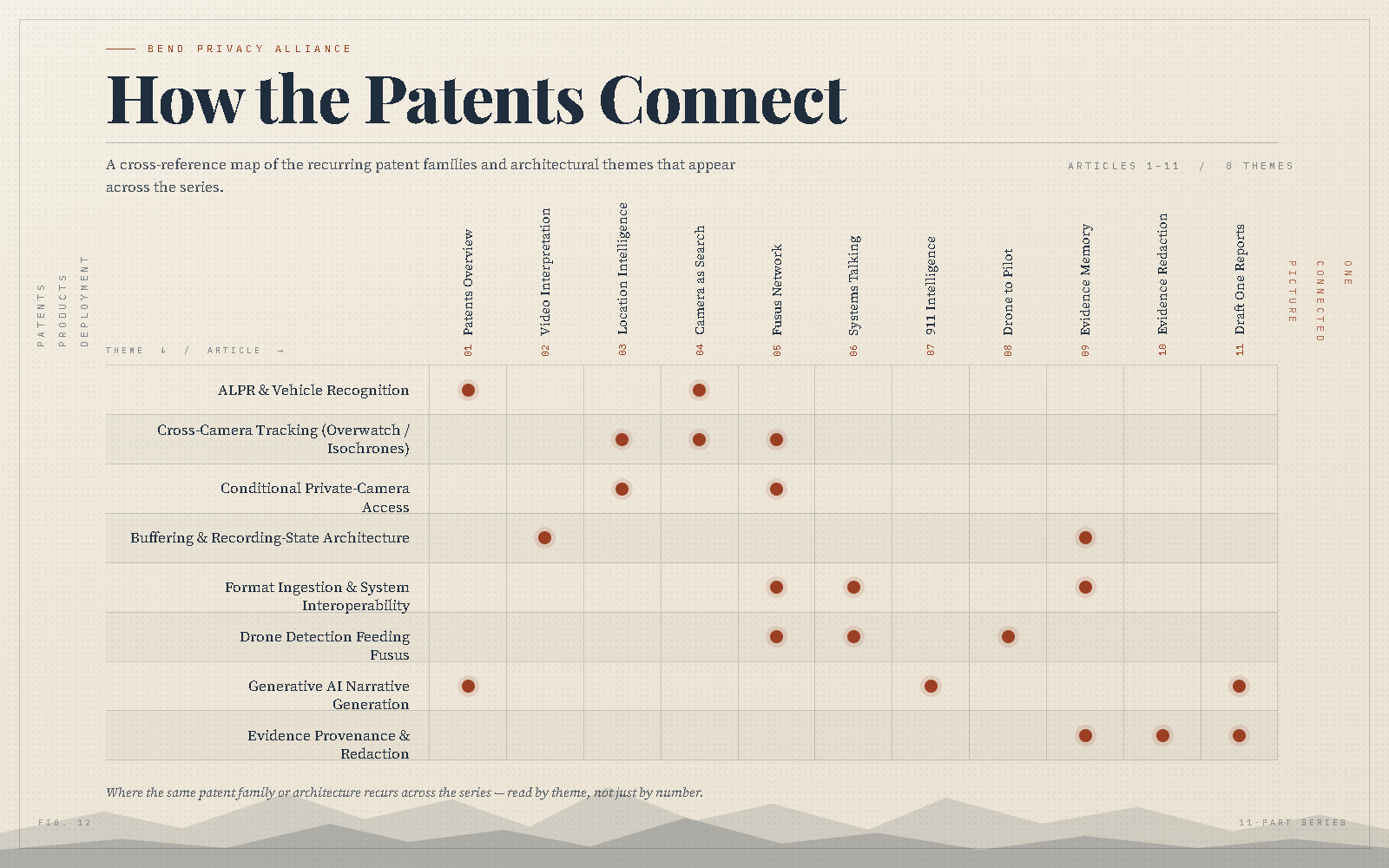
Axon Enterprise is best known for body cameras and Tasers, but its patent portfolio and current commercial products describe a much larger system: license-plate search and tracking, cross-camera object following, AI-generated police reports, drone detection and location, redaction and evidence transformation, and a growing set of tools for connecting all of it together.
This series follows that architecture piece by piece. Throughout, it distinguishes among four different kinds of evidence, and keeps them separate rather than treating one as proof of another:
A patent shows what Axon claimed or disclosed. Current product documentation shows what Axon commercially offers today. Local procurement records establish what Bend has purchased. None of those, by itself, establishes local deployment or use — and the series is careful to say so at every point where the evidence runs out.
The Series
- What Axon’s Patents Tell Us About the Future of Police Surveillance
An investigation into Axon patents, Fusus tracking technology, Draft One, ALPR, drones, evidence systems, and Bend, Oregon — and what they reveal about the future of police surveillance oversight. - When Video Becomes an Interpretation
A Bend Privacy Alliance analysis of Axon patents covering adaptive buffering, detail-frame capture, inferred field of view, and simulated human perception—and why evidence provenance matters. - More Than a Dot on a Map
Axon’s location systems are becoming more than GPS metadata. Patents and current product documentation show geography, camera orientation, movement, and visible object attributes being used to organize evidence, surface cameras, track movement, apply geofences, and guide operational decisions. - When Does a Camera Become a Search?
Oregon’s Supreme Court is reviewing four weeks of warrantless pole-camera surveillance in State v. Lane. The case raises larger questions about ALPR, Fusus, camera networks, and what happens when many public observations are combined. - The Camera Network That Knows What to Look At Next
A sourced analysis of Bend, Oregon’s Fusus surveillance system, including Axon contracts, body cameras, Fleet 3, ALPR, Axon Air drones, private-camera integration, Overwatch, and the patent architecture behind camera-to-camera tracking. - When Surveillance Systems Start Talking to Each Other
Axon and Fusus can connect surveillance systems made by other vendors, translate their data into a common operational model, share evidence across organizations, and send events onward to other systems — and what that means for Bend. - When a 911 Call Becomes Intelligence
A 911 call can now become far more than a recording. Axon’s emergency-communications architecture can transform caller audio, video, location, transcripts, AI summaries, priority, and structured details into real-time operational intelligence — and, in some configurations, longer-lived evidence. - From Drone to Pilot
A drone detector can do more than find an aircraft. Axon Dedrone can combine RF, radar, Remote ID, cameras, and other sensors to track a drone, surface pilot or launch-location information, share it through Fusus, and support a response. - What Does the Evidence Remember?
A police video may be only one layer of the record. Axon’s patents describe audit trails, recording triggers, expected evidence, derivative files, and machine-generated information that can sit behind what a later reviewer sees. - What Happened to the Evidence?
Axon’s current products and patents show that a redacted police video can be the end product of machine detection, transcripts, object tracking, configuration choices, and human corrections — and asks whether the transformation itself leaves an auditable record. - The Report Behind the Report: How Axon Draft One Changes Police Writing
Axon Draft One can turn body-camera transcripts and other inputs into police-report narratives that officers review and adopt. Independent research, agency policies, new state laws, and Axon’s own patent record point to a deeper accountability issue: what survives between the original evidence and the final report?
Related Resources
The series draws on a larger body of primary-source material and earlier Bend Privacy Alliance reporting. These pages are organized separately because they serve a different purpose: rather than developing an argument, they collect underlying documents and earlier public-record work for anyone who wants to go further.
Primary Source Documents
A curated set of primary documents behind the Bend surveillance oversight work, including vendor materials, procurement records, and background reporting.
- Source Library: Bend Surveillance Oversight — the hub page for all source-library sections below.
- Vendor & Product Documentation
- Deschutes County / DCSO Materials
- Background Reporting & Investigations
- Policy, Legal & Watchdog Sources
- Police Technology Procurement & Contracts
Related Analysis & Public Comments
Earlier Bend Privacy Alliance writing and public testimony on Bend’s Axon relationship, published before this patent series.
- This Is Not Just About Cameras
- What Police Technology Has Bend Already Considered or Purchased?
- Why Vendor Lock-In Matters in Police Technology Contracts
- AI Police Reports and the Audit Problem
- Other Cities Are Already Asking Better Questions
- Written Comment: Contract No. 2026-0327 (BOCC, June 3, 2026)
- Public Comment — May 27, Agenda Item #6, Contract No. 2026-0327
- Speaking to Bend City Council About Axon and Police Accountability
- Bend Retail Surveillance Explainer
- What Two Weeks of Advocacy Accomplished — And What Comes Next