Part 8 of the Bend Surveillance Oversight series.
Bend does not need to invent police surveillance oversight from scratch.
Other cities are already asking the same basic questions:
- Who approves surveillance technology before it is used?
- What data is collected?
- How long is it kept?
- Who can search it?
- Can outside agencies access it?
- Can vendors change settings or activate new features?
- Does the public receive annual reports?
- Can elected officials review the system before it expands?
That is the important lesson.
The issue is not whether every city has reached the same conclusion.
They have not.
The issue is that communities across the country are realizing that police technology should not expand faster than public oversight.
Austin: surveillance technology should require public rules
Austin offers one useful model.
In February 2026, the Austin City Council passed a resolution called the Transparent and Responsible Use of Surveillance Technology Act, or TRUST Act.
The resolution directed the City Manager to return with an ordinance regulating the adoption, acquisition, deployment, use, and review of surveillance technology by city departments.
That matters because it shifts the question from one contract at a time to a broader public framework.
Bend could take the same approach.
The public question should not only be whether a single contract sounds reasonable.
The broader question should be what rules apply before surveillance technology is acquired, expanded, renewed, or materially changed.
Mountain View: vendor assurances were not enough
Mountain View, California offers another useful lesson.
In January 2026, the City publicly stated that it had discovered unauthorized queries and potential access to Mountain View ALPR data.
The City said Police Department staff had met with Flock Safety leadership about “the security and control of our data,” and said it was “upset and disappointed with how our data was accessed.”
That example matters because it shows why vendor assurances are not enough.
The lesson for Bend is simple:
Do not wait for a data-sharing problem before creating data-sharing rules.
Pima County: cost and AI concerns can cross political lines
Pima County, Arizona offers another example.
Reporting in early 2026 described the Pima County Board of Supervisors rejecting a proposed $45 million contract expansion involving Axon technology and AI tools.
Reported concerns included cost, AI expansion, and whether the investment made sense for the Sheriff’s Department.
That example matters because surveillance oversight is not only a privacy issue.
It is also a budget issue.
Public safety dollars are limited.
Every dollar spent on bundled technology, AI tools, cloud subscriptions, hardware refreshes, and add-on features is a dollar not spent somewhere else.
That does not mean technology is never worth funding.
It means elected officials should ask hard questions before long-term commitments become automatic.
Ferndale: public pressure can lead to stronger oversight
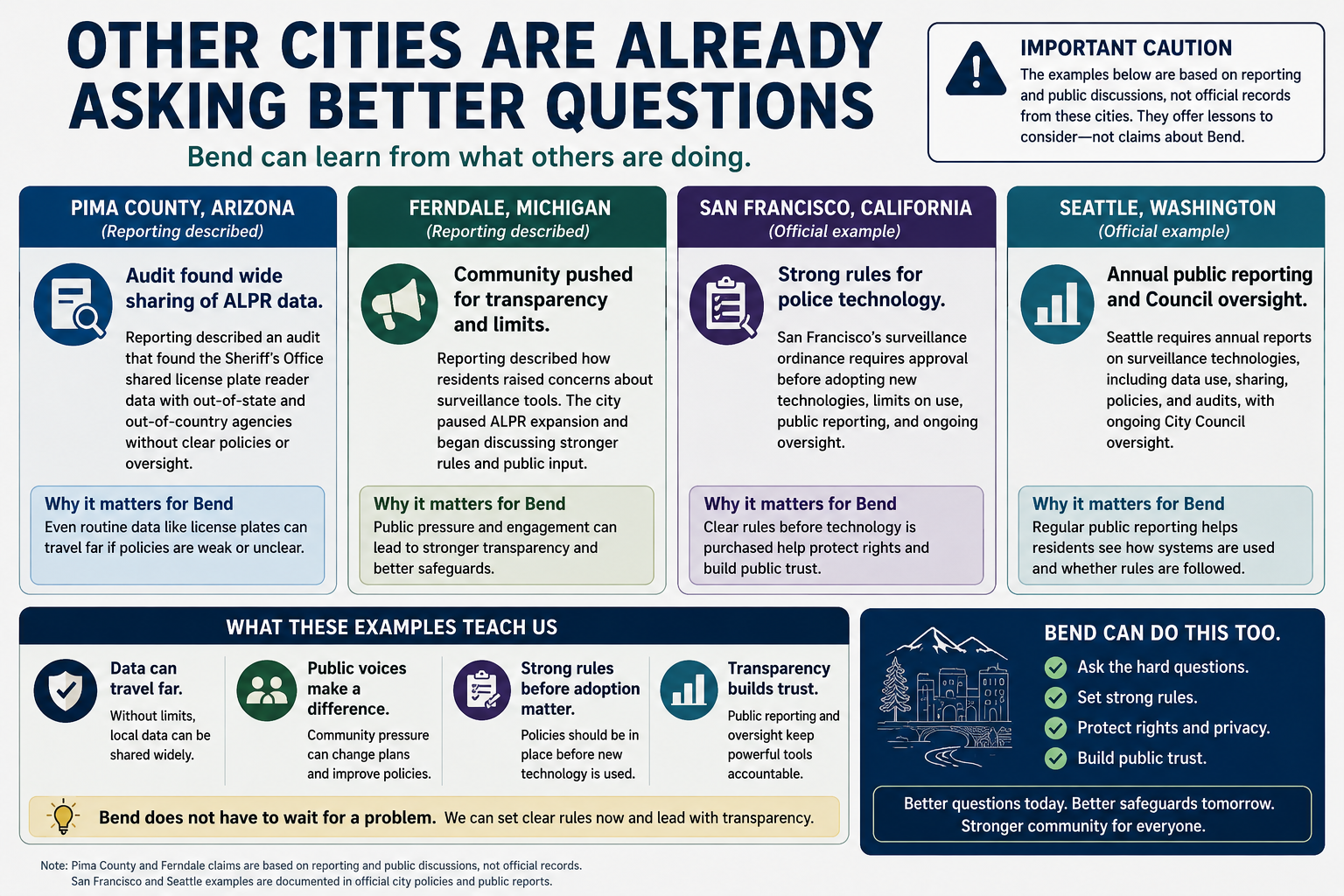
Ferndale, Michigan offers another useful example based on reporting about local ALPR oversight discussions.
Reporting described residents raising concerns about license plate reader expansion and city officials discussing stronger policies.
That is important because public oversight often improves when residents ask specific, grounded questions.
Community engagement does not have to stop technology.
It can improve the rules that govern technology.
The pattern is bigger than one vendor
This is not only about Axon.
It is not only about Flock.
It is not only about ALPRs.
It is not only about body cameras.
It is not only about AI.
The larger issue is how cities govern powerful surveillance systems once cameras, cloud storage, software subscriptions, data-sharing, analytics, and vendor platforms become part of public safety operations.
A city can support public safety and still insist on public oversight.
Those goals are not opposites.
What Bend can learn
Bend can learn at least five things from other cities.
- Oversight should happen before deployment or expansion, not after controversy.
- Citywide rules are better than one-off contract debates.
- Data-sharing limits should be explicit and enforceable.
- Vendors should not be the only source of truth about how systems work.
- Annual public reporting builds trust without exposing sensitive case details.
These examples do not prove that Bend has the same problems.
They show why Bend should adopt safeguards before problems occur.
Bend can ask better questions now
Police technology can be useful.
But useful tools still need rules.
If other cities are asking stronger questions about surveillance technology, Bend can too.
The question is not whether Bend should copy another city word for word.
The question is whether Bend should create its own public framework before future expansions become harder to unwind.
Better questions today can prevent harder problems tomorrow.
Further reading
- Austin TRUST Act resolution backup document
- FOX 7 Austin: Austin City Council passes TRUST Act
- City of Mountain View statement on ALPR data access
- Mountain View Voice: unauthorized access to license plate data
- KOLD: Pima County supervisors reject $45 million AI contract
- C&G Newspapers: Ferndale to work on policies to strengthen ALPR camera oversight
- Bend Surveillance Oversight Source Library
Leave a Reply